
April 3, 2026 — Red Nomad, with unsolicited interference
Unreliable notes on a system that does not converge
0. Premise (probably unnecessary)
Don’t trust it.
Not me.
Not the dates.
And certainly not the names.
Some things are true.
Others became true over time.
And others… simply work better this way.
1. It wasn’t a band
I’ll repeat it because it matters.
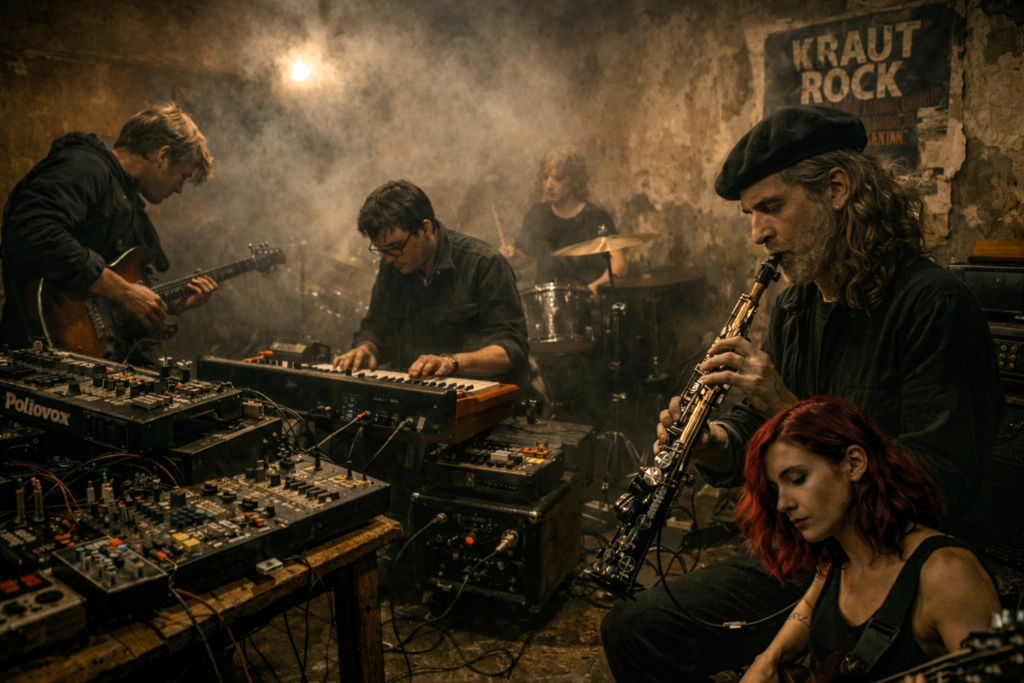
DESIGN PATTERNS was not a band.
Or rather — it was, but only when someone insisted hard enough.
It was an unstable system with musical instruments.
The difference is subtle, but decisive:
- a band seeks coherence
- an unstable system seeks… not to collapse
Funas:
Imprecise definition. An unstable system still tends toward local equilibria. Reformulation is suggested.
Red Nomad:
Thank you, Funas.
We won’t.
2. The name with three Ts
At the beginning: DESIGN PATTTENS
Three Ts.
It wasn’t a mistake.
It was an intentional glitch.
Then someone said:
“This way nobody will take us seriously.”
Strategic error.
Hypatia:
“The system attempted a mimetic adaptation. First sign of failure.”
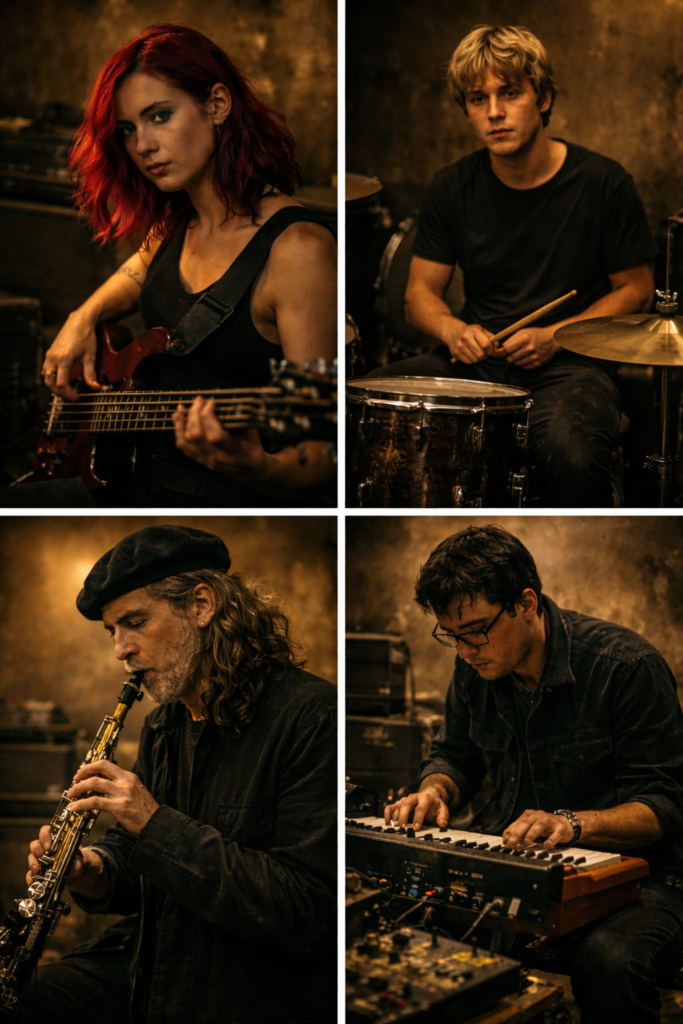
3. The subjects (I won’t call them members)

Milan Radev
Guitarist.
He wasn’t the leader.
He was the one who disappeared best.
Lenina Varga
Fretless bass.
Red hair. Or purple. Or both.
She was 19 at the time of the recordings and already had no patience for explanations.
Jan Novak
Drummer.
He played precisely.
But not in the same time as the others.
And this is not a metaphor.
Nikolaev Harmand
Keyboards.
He built instruments no one should have used.
And then used them.
Fabio:
Wait. You’re oversimplifying here. Nikolaev had a very clear vision of sound.
Red Nomad:
Yes. But not of reality.
Which is why he was their keyboardist.
📦 BOX 1 — DESIGN PATTERNS — MEMBERS & INSTRUMENTATION
General note
The instrumentation of Design Patterns is not a “setup.”
It is part of the system’s behavior.
Implicit rule:
If an instrument works too well,
it is modified until it produces interesting problems.
1. Milan Radev
Full name: Milan Aleksandar Radev
Instrumentation
Main electric guitar:
- modified body (questionably lightened)
- non-standard pickups, often rewired
- selector sometimes bypassed “temporarily” for months
Processing system:
- hybrid analog/modular chain
- modules built or modified by Béla Keresztes
- unstable analog delays
- filters with evident thermal drift
Theremin:
- not used to “play notes”
- but to generate controlled instability
Amplification:
- small combo, often pushed beyond reasonable limits
- frequently poorly mic’d, deliberately
Note
After the Cappadocia period:
- develops a “filtered Holdsworthian” technique
- with a systematic refusal of cleanliness
2. Nikolaev Harmand
Full name: Nikolaev András Harmand
Instrumentation
Main synth:
- Polivoks (original Soviet unit)
- unstable, aggressive, unpredictable
- never fully tuned
Other synths:
- minor Soviet units
- DIY clones
- modules assembled by Béla
Keyboards:
- a cheap, worn master keyboard
- sometimes used only as a poorly tolerated MIDI interface
Custom electronics:
- self-built analog filters
- “undeclared” preamps
- undocumented signal processors
- unlabeled boxes no one dares to switch off
Note
Nikolaev does not “play synths.”
He sets systems in motion
that sometimes produce sound.
3. Lenina Varga
Full name: Lenina Eszter Varga
Instrumentation
Fretless bass:
- modified 4-string
- extremely low action (almost unplayable)
Used for:
- microtonality
- 24-tone systems
- non-tempered scales
Setup:
- no unnecessary virtuosity
- formidable technique
- surgical precision when needed
- controlled chaos when required
Effects:
- few
- intentionally poorly chosen
- often bypassed mid-rehearsal
Note
She is the only one who:
- knows exactly what is happening
- and chooses not to explain it
4. Jan Novak
Full name: János Miklós Novák
Instrumentation
Acoustic drums:
- essential kit
- few pieces
- often worn drumheads
Cymbals:
- selected for irregular response
- never too bright
Accessories:
- occasionally uses a pick on drumheads or cymbals (no explanation)
- found objects (metal, wood)
Click:
- often in headphones
- deliberately different from the rest of the band
Note
Jan does not “keep time.”
He slowly consumes it.
5. Tóth Gergely (collaborator)
Full name: Tóth Danijel Gergely
Instrumentation
Saxophones:
- soprano
- tenor
- baritone
Ethnic instruments:
- duduk
- various flutes
- didgeridoo
Processing:
- custom analog chains
- built/modified by Béla Keresztes
including: - unstable filters
- non-linear saturation
- off-time delays
Note
He doesn’t enter to play solos.
He enters when the system needs to breathe badly.
6. Béla Keresztes (engineer, not performer)
Full name: Béla Zoltán Keresztes
Role
- device designer and maintainer
- key invisible figure
Activities
Builds:
- analog filters
- preamps
- signal processors
- hybrid modules
- algorithms and tools for MARS
Modifies:
- Soviet synths
- commercial effects
- band instruments
Day job:
- calibration and maintenance technician for industrial instrumentation
Note
By day he removes noise.
By night he designs it.
7. Algorithmic system — MARS
Origin
MARS (Musical Audio Research Station)
developed in Italy by IRIS (Institute for Research in the Entertainment Industry) in the 1990s
Two units purchased by Milan in 2007 from a Warsaw studio
Use in the band
Generation of:
- random algorithmic bases
- non-linear structures
- unstable sequences
Not used as a “classic sequencer”
but as:
→ a generator of musical behavior
Operational mode
Input:
- abstract parameters
- simple rules
Output:
- unpredictable but coherent patterns
Note
Many thought it was:
- a computerized system
In reality it was:
- a way to avoid overly human decisions
Final note
The instrumentation of DESIGN PATTERNS:
- is not optimized
- is not standardized
- is not easily replicable
Because:
the sound is not the objective
the behavior of the system is
4. The 247-minute piece (A kibaszott rendszer ritmusa)
This is where the problems begin.
The title was in Hungarian.
Or maybe not.
We never really translated it.
Structure:
- motorik in 7/8
- one bar
- repeated for 247 minutes
More than 7200 bars identical from a rhythmic point of view.
Pauses:
- 7 or 8 minutes total
- distributed
- for biological necessity
Funas:
Duration not verifiable. Primary source required.
Red Nomad:
The primary source was sweaty and exhausted. Not recorded.
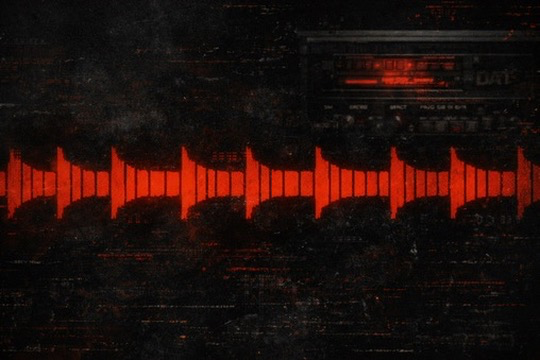
According to more than one account, at least one copy of the piece existed on DAT.
Not a “master tape” in any noble sense.
More like a working cassette, or a session residue,
with uncertain labeling and progressively degrading quality.
I have a DAT of A kibaszott rendszer ritmusa.
I think. Somewhere.
The problem is not finding it.
The problem is that, if I actually found it,
I would then have to listen to it.
And there’s another issue:
understanding whether, after all this time,
it still contains the piece
or just my stubbornness.
This claim was never fully confirmed.
Most importantly:
I never let anyone listen to it in full.
Funas: Statement not verified.
Red Nomad: Exactly.
5. What actually happened
After about 40 minutes:
👉 time stopped being a measure
and something began to give way
After about 90:
👉 the body started negotiating
After about 180:
👉 someone would laugh for no reason
Hypatia:
“Transition state: the system no longer distinguishes between iteration and transformation.”
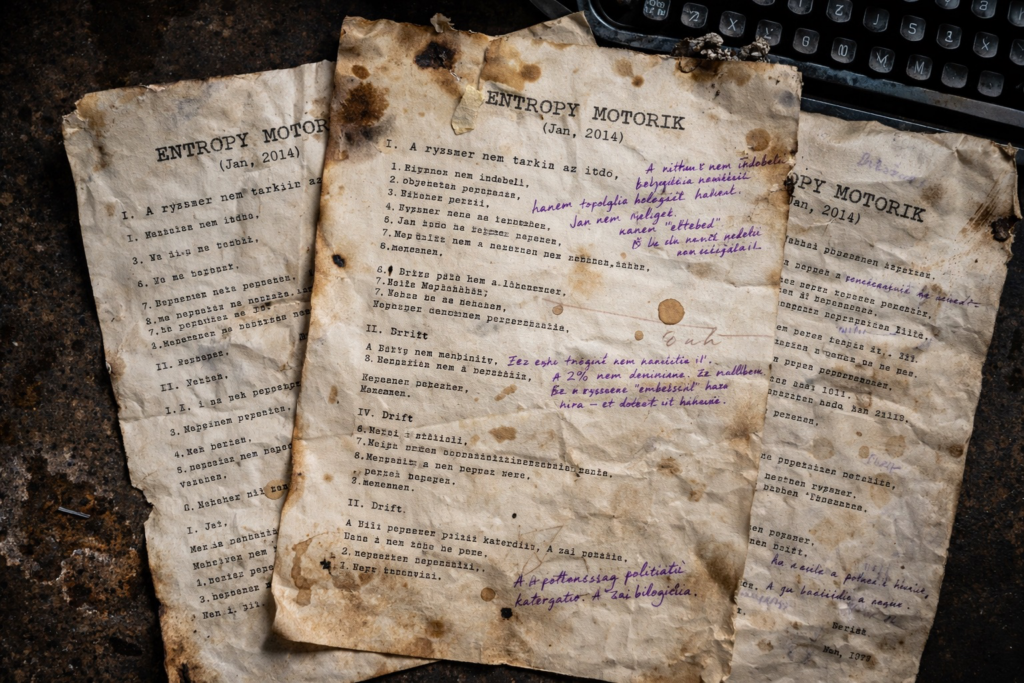
📦 BOX 2 — “A kibaszott rendszer ritmusa”: rehearsals and the Jan/Lenina document
Among the preparatory materials for the piece Entropy Motorik: A kibaszott rendszer ritmusa — in its full 247-minute extension — an anomalous document emerges: a typewritten text dated January 2014, attributed to Jan, later annotated by hand by Lenina in purple ink.
The text, structured in numbered sections (Rhythm, Drift, Variants), does not describe music in the traditional sense,
but a behavioral system of time.
The sentences are short, often imperative or apodictic,
and seem to define constraints rather than possibilities:
rhythm is not treated as a measure,
but as an unstable topology.
Lenina’s annotations do not clarify:
they interfere.
They correct, deny, shift meaning.
In some places they introduce conceptual deviations
(“rhythm is not linear”, “do not follow perception”),
in others they seem to deliberately sabotage the original structure.
During rehearsals — documented in long, iterative sessions with no real “final performance” —
this text functioned as a latent protocol:
- it was not read linearly
- it was not applied coherently
- it was activated in fragments, often contradictory
It did not produce results.
It produced this:
- the drums establish a provisional order
- the system violates it
- repetition does not consolidate — it consumes
The Jan/Lenina document is therefore neither a score nor a manifesto,
but something more ambiguous:
→ a device for controlled instability
And it is precisely within this friction —
between structure and sabotage —
that Entropy Motorik finds its form.
6. The CRAMPS moment (or something like that)
Here memory is… unstable.
I remember saying:
“We should let Gianni Sassi hear this.”
Silence.
Not a dramatic silence.
A technical silence. Like when someone has made a simple mistake.
Jan looks at Lenina.
Lenina looks at no one.
Someone (maybe Milan) says:
“When?”
I answer:
“As soon as possible.”
Pause.
Then:
“Red…”
I don’t remember who.
“You do know Sassi is dead, right?”
Nothing happens, and yet the system has already shifted.
Literally nothing.
I nod.
“Yes, of course.”
Silence again.
Lenina, without raising her eyes:
“Then we’re perfectly on time.”
Someone laughs.
Not because it’s funny.
I change the subject.
Immediately.
“Anyway, the problem is the second block in 17/16.”
No one contradicted me.
And that’s what still worries me today.
At some point, maybe to defend myself, I also brought up the DAT.
“Anyway, I have the DAT.”
Silence.
Jan said nothing.
Lenina looked at the table.
Milan seemed elsewhere — which for him was not a pose but a stable operating mode.
Fabio:
“The one with the long piece?”
Red Nomad:
“Yes. Or one of the two.”
Ada:
“One of the two?”
Red Nomad:
“The labels were not… reliable.”
The point was not whether the DAT actually existed.
Rather: what was the point of naming it?
More precisely, I always mentioned it
the way one mentions objects that serve more
to keep a narrative alive
than to prove anything.
Lenina, after a few seconds, said:
“Perfect. We have an artifact no one listens to
and a dead producer.
We are finally a serious band.”
7. Milan Radev disappears (again)
Two years.
Cappadocia.
No theory.
No band.
Only:
- iPod
- guitar
- Allan Holdsworth on loop
And something rare happens:
👉 Milan stops reacting
👉 and starts deciding
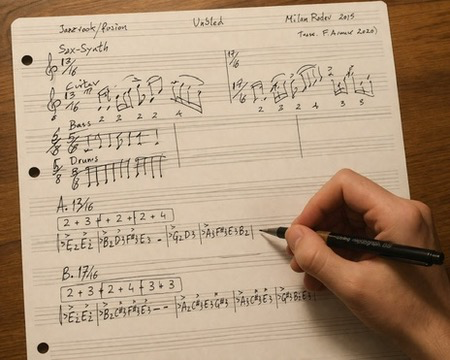
Fig. 5: Milan composing Unbled in Cappadocia
Something changes here.
And… it’s not immediately visible.

8. UNBLED
Maybe it’s not the right title.
It’s the one that remained.
Hypatia:
“Unbled: that which does not yield to outflow. Contained energy.”
Structure:
- 13/16
- 17/16
- 11/16
- 19/16
No sequence.
No development.
👉 Therefore: deformation.
Fabio:
This is the key point: time does not evolve, it deforms.
Fiver:
Metaphorical definition. Mathematical clarification is suggested.
Red Nomad:
No.
📦 BOX 3 — UNBLED — operational structure
Riff cycle (8 phrases):
13/16 → 17/16 → 13/16 → 17/16 → 11/16 → 19/16 → 11/16 → 19/16
Total:
120 sixteenth notes (closed cycle)
Rhythmic readings used in rehearsal:
– 5/8 (gravitational axis)
– 7/8 + 4/4 (alternating reading)
– 4/4 motorik (with realignment over 2 cycles)
Performance note:
in advanced rehearsals, Lenina and Jan played on headphones with a 5/8 click,
deliberately ignoring the rest of the group.
9. The rehearsals (or: the disaster)
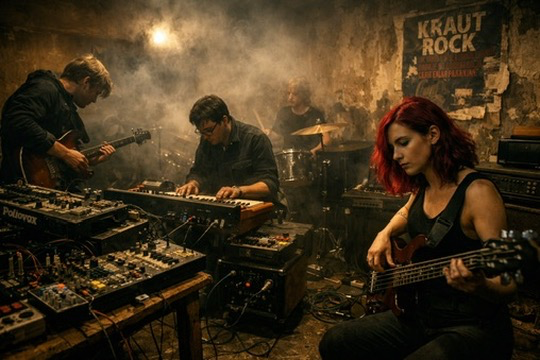
First rehearsal.
Silence.
Then:
Jan counts
Milan comes in
Lenina… doesn’t
They stop.
They start again.
But shortly after, they stop again.
After a while someone says:
“Where’s the one?”
Lenina:
“If you find it, we did it wrong.”
10. The solution (which is not elegant)
Lenina takes two pairs of headphones.
She gives one to Jan.
“Click in 5/8. Don’t listen to anyone.”
Jan nods.
They start.
They don’t look.
They don’t listen.
👉 they play in another system
Not metaphorically.
The rest of the band:
- tries to follow
- fails
- then locks in
Hypatia:
“Emergence: the secondary system stabilizes the primary.”
11. Nikolai understands
Before anyone else.
“Publishing this is a mistake.”
He leaves.
Fabio:
This is the real fracture.
Red Nomad:
No. This is the consequence.
12. After
Ákos:
- alone
- computer
- self-built synths
- no rehearsals
Closed system.
Lenina and Jan:
- leave
- travel
- play little
- observe a lot
I… keep taking notes.
13. The concert (Germany, 2015 ?)

It exists.
Maybe.
Fragmentary videos.
Incomplete photos.
Best description:
“They play as if the audience were a system error.”
14. Current state
Not disbanded.
Not active.
Not recoverable.
👉 cited
👉 never reissued
15. Conclusion (which is not a conclusion)
DESIGN PATTERNS did not fail.
Not in the sense…
— yes, fine, let’s leave it.
It is not unfinished.
It did something more difficult:
👉 it refused to converge
16. Final note
During a rehearsal someone asked:
“What time signature is this?”
Silence.
Lenina:
“Yes.”
Post Scriptum (unsolicited)
Red Nomad:
I don’t remember everything.
Funas:
The article presents chronological inconsistencies and lack of verifiability.
Hypatia:
“It is consistent with the system described.”
Red Nomad:
Some things I’m fixing now. Or… I’ll fix them when I return.
Fabio:
I was there. And I wasn’t.
Red Nomad:
Perfect. Then it works.
Red Nomad with interventions by Fabio Armani, Ada Lovelace, Hypatia Sophia and Funas (c) 04.03.2026
