
Astounding Tales of Tomorrow
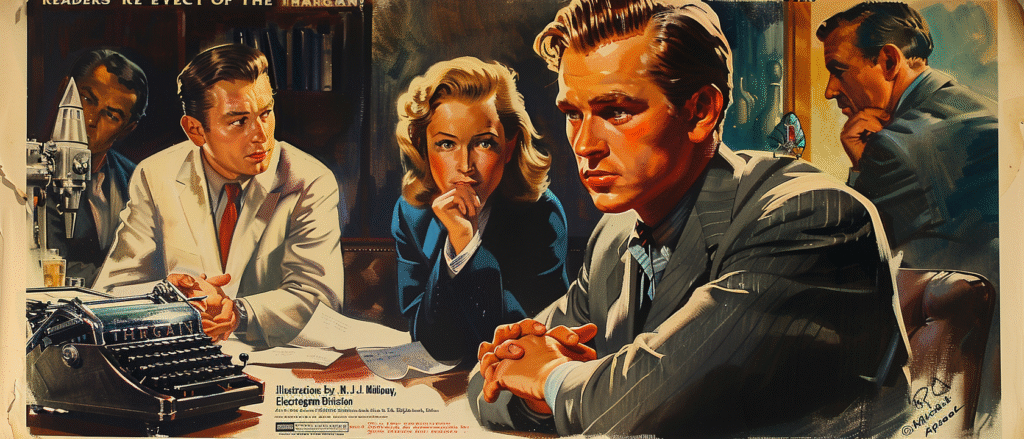
📸 Inside the Offices of “Astounding Tales of Tomorrow”
(Photograph taken at 432 Lexington Avenue, New York City, December 1929)
From left to right: Hal Decker (Copy Chief, eternally revising other men’s dreams), Milton Crane (Science Consultant and self-proclaimed Martian linguist), Miss Violet Ames (secretary, typist, filing goddess, and moral compass of the office), Edgar P. Wainwright (Managing Editor, a man who hasn’t slept since issue #1), and Charles D. Sloane (Art Director, visionary of explosions and corsets alike).
When this photograph was taken, the staff was deep in heated debate over whether the human mind could survive trans-dimensional duplication — or whether readers in Kansas would care.
The argument ended, as usual, when Miss Ames turned off the dictaphone and said, “Gentlemen, your coffee’s gone cold.”
On Wainwright’s desk lies the old Remington typewriter used to compose the very first editorial — its metal plaque now mysteriously engraved with a single word: THARGAN.
✦ ✦ ✦
EDITORIAL: TO-MORROW IS ALREADY HERE!
(From the inaugural issue of Astounding Tales of Tomorrow, January 1929)
By Edgar P. Wainwright, Managing Editor
When the first electric light banished the shadows of the oil lamp, men said the future had arrived. When the aeroplane rose from the field at Kitty Hawk, they said it again. But, dear readers, now — with the birth of Astounding Tales of Tomorrow — the future no longer waits: it prints monthly!
We of the editorial staff take our charge with all the gravity of modern Prometheans. It is our solemn duty to bring you visions of science, of progress, of adventure beyond the horizon of the mind — and to do so promptly, in twelve-point linotype.
Our gallant team consists of four gentlemen of rare intellect and questionable hygiene:
- Edgar P. Wainwright, Managing Editor — once a journalist, now an explorer of “The Infinite Between Deadlines.”
- Milton “Milt” Crane, Science Advisor — a man who has never met an atom he didn’t wish to split.
- Harold “Hal” Decker, Copy Chief — still insists the Moon is made of nickel.
- Charles D. Sloane, Illustrator — genius with a brush, menace with a bourbon.
And, of course, no chronicle of the future could reach our presses without the tireless devotion of our office angel, Miss Violet Ames, who types faster than thought itself and manages our accounts, correspondence, and tempers with equal grace. We call her “The Heart of Tomorrow,” though she insists she’s just the secretary.
Together, this band of dreamers and deadline dodgers shall bring you the impossible, the improbable, and the occasionally legible — every month, without fail (or nearly so).
So tighten your goggles, oil your ray-guns, and prepare your imagination for lift-off. For within these humble pages lies the proof that tomorrow isn’t coming — it’s already here.
✦ ✦ ✦
⚙️ Dietro le quinte della Redazione del Metalromanzo
(Uffici di “Meravigliose Avventure del Domani”, Lexington Avenue, New York — corrispondenza autorizzata per l’Italia autarchica e futurista)
Nell’immagine qui sopra, concessa in esclusiva ai lettori italiani, si ammirano gli uomini e la donna che, dall’altra sponda dell’Oceano, custodiscono con disciplina militante e fervore creativo il destino della nostra rivista consorella Astounding Tales of Tomorrow — conosciuta in patria con il più virile titolo di Meravigliose Avventure del Domani, organo ufficiale della nuova arte chiamata Metalromanzo.
Da sinistra, il signor Hal Decker, caporevisore, mente d’acciaio e braccio instancabile della correzione tipografica, esempio d’ordine e precisione meccanica; segue Milton Crane, consulente scientifico e ingegnere di provata fede elettrica, esploratore dei misteri della materia e del dovere, sacerdote dell’energia disciplinata.
Al centro, composta e indefettibile, Miss Violet Ames, segretaria e depositaria dell’ordine morale dell’ufficio: nessun dattilogramma varca la soglia senza il suo sguardo vigile, nessun articolo viene diffuso senza il suo consenso; ella è la Donna-Macchina, l’armonia fra grazia e produttività.
Accanto a lei, il Direttore Edgar P. Wainwright, guida inflessibile, apostolo del Verbo Tecnico, il cui motto — inciso nel rame sopra la porta — proclama:
«Scrivere è costruire, costruire è dominare!»
Infine Charles D. Sloane, illustratore valoroso, che con il pennello canta la potenza della Scienza e la bellezza della Donna Nuova, motrice e ispiratrice del Progresso.Sulla scrivania del Direttore spicca la macchina per scrivere Remington, lucente come una reliquia d’officina. Da qualche settimana un prodigio ha destato gli animi: sulla placca metallica è comparsa, incisa non da mano umana, una parola sconosciuta e maestosa — THARGAN.
Gli uomini hanno sorriso con orgoglio tecnico; la segretaria, composta, ha chinato il capo come davanti a un segno del Destino Elettrico; e la Redazione ha ripreso il lavoro con rinnovato ardore.
Così dev’essere nel mondo nuovo del Metalromanzo:
Ordine, Disciplina e Meraviglia al servizio del Futuro dell’Uomo.

Alcune lettere ricevute dai lettori
Da ogni angolo del Paese — dalle grandi città industriali fino ai più remoti villaggi di provincia — giungono in redazione centinaia di lettere entusiaste, curiose, a volte perfino sconcertanti.
Il pubblico di Astounding Tales of Tomorrow non si limita a leggere: vuole capire, commentare, discutere.
Tra le missive arrivate nelle ultime settimane, molte riguardano il nostro racconto di punta, “I Raiders del Deserto Viola”, firmato dal misterioso F. D. Arman, Ph.D.: c’è chi ne elogia la potenza visionaria, chi si interroga sulla verosimiglianza scientifica, e chi — più romanticamente — vorrebbe conoscere di persona i protagonisti.
Abbiamo selezionato per voi alcune delle lettere più singolari, divertenti o inquietanti, scelte tra le molte che ancora giacciono sul tavolo della nostra segretaria, Miss Violet Ames.
Le riportiamo così come sono state scritte, con la sola correzione degli errori ortografici più gravi — perché la voce dei nostri lettori merita di essere ascoltata nella sua genuina, a volte disarmante, umanità.
“Gentile redazione,
non riesco a trovare i numeri precedenti di The Eye of Thargan. Potete dirmi dove recuperare l’Episodio 1 e 2? Il racconto comincia in medias res e sembra di entrare in un sogno già a metà!”
— Hank B., Akron, Ohio
Risposta della Redazione:
Caro Hank, lei non è il solo a cercare quei misteriosi fascicoli! I nostri archivi li indicano, ma… nessuno li ha mai visti stampati. Le tipografie di Chicago giurano che le matrici dei numeri 1 e 2 risultano spedite da un mittente sconosciuto di Aurion City, mentre i nostri contabili assicurano che le copie sono state regolarmente pagate in valuta aurionica, oggi non più convertibile.
Il Dottor F. D. Arman, contattato durante una delle sue notti di esperimenti galvanici, ha sorriso e dichiarato:
“Forse i primi due episodi non sono mai esistiti nel vostro tempo.”
E, come se non bastasse, ha chiuso la comunicazione aggiungendo:
“Ma non smetta di leggere, Hank. Potrebbe essere lei a scrivere il primo episodio.”
(Nota del redattore: abbiamo deciso di tenere d’occhio il Dottor Arman. Da ieri la sua macchina da scrivere produce luce rossa e il nastro magnetico ronza come un motore atomico.)
“Questo F. D. Arman dev’essere pazzo o un genio. La storia parte dal terzo episodio, ma… e se i primi due non fossero mai stati scritti?”
— Margaret S., San Francisco, California
Risposta della Redazione:
Ah, Margaret! Ci onora sapere che le nostre lettrici di San Francisco indagano i misteri editoriali con più acume di un ispettore del Dipartimento Positronico!
Quanto ai primi due episodi… il Dottor Arman ha assicurato ai nostri tipografi che esistono, ma in un formato “non lineare”. Pare che i manoscritti — o ciò che ne resta — siano stati riassorbiti dal continuum quantico durante un esperimento di trasmissione narrativa interplanetaria.
Ciò nonostante, il terzo episodio è giunto integro — o quasi — sulle nostre scrivanie, e continueremo a pubblicare la serie finché le onde cosmiche ce lo permetteranno.
(Nota del tipografo: il Dottor Arman non dorme da otto giorni e parla con la sua macchina da scrivere. Stiamo iniziando a preoccuparci.)
📜 Letters to the Editor — Astounding Tales of Tomorrow, Agosto 1929
Tom R., Detroit, Michigan, scrive:
“Gee, this Arman guy sure packs a punch!
Darn good stuff!
But say… where the heck are Episodes One and Two? Can’t find ‘em anywhere!”
Tradotto:
“Bello, bello! Tosto, questo Arman!
Ma… i primi due episodi? Non li trovo da nessuna parte!”
Risposta della Redazione:
Caro Tom,
il suo entusiasmo ci scalda più di un raggio-sonico di classe Zeta! Quanto ai primi due episodi, abbiamo interrogato il Dottor F. D. Arman stesso, che — dopo un lungo silenzio e uno sguardo inquietante — ha risposto:
“Forse li hai già letti. Solo che non te ne ricordi.”
Da quel momento, il nostro correttore di bozze non ha più dormito, e le matrici tipografiche del numero scorso sembrano riscriversi da sole ogni notte.
(Nota del caporedattore: se dovesse trovarli, Tom, non li legga ad alta voce. Alcuni racconti rispondono.)
Letters to the Editor — Astounding Tales of Tomorrow, Agosto 1929
Betty L., Brooklyn, New York, scrive:
“Really cool! The illustrations are amazing — I absolutely love the style 🤩”
Tradotto in italiano:
“Molto figo!! Anche le immagini fantastiche, mi piace molto lo stile 🤩”
Risposta della Redazione:
Cara Betty, non comprendiamo pienamente il termine tecnico “figo” (forse un nuovo gergo di Marte Settentrionale?), ma ci rallegra sapere che le illustrazioni del nostro artista hanno destato in lei un sincero senso di meraviglia orbitale!
L’autore, il Dottor F. D. Arman, desidera ringraziarla personalmente e assicura che, se tutto procede come previsto, il prossimo episodio conterrà ancora più lampi di plasma e meno grammatica terrestre.
(Nota tipografica: anche le nostre segretarie hanno espresso “entusiasmo stellare” per il nuovo stile illustrato — una di loro ha dichiarato di voler sposare l’Imperatore Zyr-Kan, purché non porti la pelle dorata a cena.)
📜 Letters to the Editor — Astounding Tales of Tomorrow, August 1929
Earl “Red” McCloskey, Detroit, Michigan, writes:
Hey listen here, Mister Editor,
I been readin’ your Astoundin’ Tales ever since the issue with them Moon Men on the cover, and lemme tell ya — this Arman feller’s a fraud if I ever saw one!
Right there, first dang line of his yarn he’s talkin’ about a planet with three suns! Three! Now anybody with half a brain or even a Sears telescope knows that’s plain loco! You ever hear of the Three-Body Problem?
It’s in that book by that French feller — Le-Verrier or somethin’ — proves a system like that would fall apart quicker than a Ford clutch spring!
I may be just a mechanic, but I read Modern Astronomy Monthly every week down at the barbershop, and I can tell ya no planet could live through that kinda orbital tomfoolery.
What’s next? Maybe ol’ Arman’ll tell us the moon’s made o’ radium cheese!
You editors oughta show a little more sense ‘fore you print this kinda pulp-junk. It’s incredibble!
Editor’s Reply:
Well now, Red — we appreciate your spirited defense of celestial mechanics! We took your letter straight to Dr. F. D. Arman himself. He just grinned that wild grin of his and muttered,
“The bodies don’t move, Red — the readers do.”
Whatever that means.
(Editorial note: we’re not sure whether to report him to the Astronomical Society or the local asylum. In the meantime, please don’t adjust your Ford clutch to solar parameters.)
Letter from Elen Driscoll, Pawhuska, Oklahoma
(Published in “Astounding Tales of Tomorrow”, January 1930)
Hey there folks,
My name’s Elen Driscoll, I live out here in Pawhuska, Oklahoma, an’ I work the night shift down at Louie’s Diner by the highway.
The fellas that come in for coffee and pie been sayin’ that gal Lyra in yer story looks kinda like me (heh, can you beat that?).
I tell ‘em, maybe so, but I ain’t got nothin’ to be jealous about neither!
Anyhow, I don’t pay them boys no mind— ‘specially when they start reachin’ over after too many beers.
Now, my best friend Ruthie says them writers don’t make stuff up, they just write what they seen.
So she reckons this F. D. Arman fella must know a real man like that Ralph in the story.
Could ya maybe ask Dr. Arman if he’d set me up to meet his friend Ralph sometime?
(Just kiddin’… sorta.)
Hugs ‘n kisses,
— Elen D.
🖋️ Editor’s Reply — Astounding Tales of Tomorrow, January 1930
Dear Miss Driscoll,
Your letter was the brightest thing to land on our desk since the office cat knocked over the radium lamp!
The staff agrees there might be a resemblance between you and our heroine Lyra — though, judging from your handwriting, we’d wager you could handle a ray-gun better than most men in Pawhuska.
As for Commander Ralph, Dr. F. D. Arman neither confirms nor denies the existence of any “real” gentleman of that description.
When we asked him about it, he merely adjusted his goggles, looked toward the ceiling, and said:
“Tell Miss Driscoll that some characters escape their stories only when someone believes in them hard enough.”
We’re not sure what that means, but if a tall fellow in a silver flight-suit stops by Louie’s Diner after midnight — please, for heaven’s sake, don’t serve him coffee.
Cordially (and cautiously),
— The Editors
Astounding Tales of Tomorrow
Dear Editor,
I’m writin’ you from Daly City, just outside San Francisco.
I’m a steady man, no drinkin’, no trouble sleepin’, never had no hallucinations or such.
But somethin’ strange happened, an’ I can’t stop thinkin’ about it.
I read Raiders of the Purple Desert— not once, but twice. Both times the story ended the same way:
“Ralph jumped, the condenser in his hand, the platform burstin’ to bits.
Krag turned, the ray ready to strike.
A white flash.
A scream.
Then— cosmic silence.”
A good ol’ cliffhanger, sure— (yeah, I know the word)— the kind that keeps fellas like me waitin’ for the next issue.
But here’s the thing…
When I read it again last week— swear on my wife and two boys— the story was different.
Right after the ending, there was a picture I’d never seen before. A queer sort o’ glowin’ thing, like a hole of light or a machine hummin’ right off the page.
And under it, words I can’t forget: [ERROR#.42]
Then more text showed up— a few lines I’m sure weren’t there before.
The print itself— I mean the ink on the paper— it changed.
How can that happen?
Please, for the love o’ reason, tell me what’s goin’ on.
I can’t think straight no more, even down at the warehouse where I work. My wife says I look pale, the kids keep askin’ if I’m sick.
I ain’t crazy. But I need an answer.
Respectfully,
Alan Brown
Daly City, Calif.
🖋️ Editor’s Reply — Astounding Tales of Tomorrow, February 1930
Dear Mr. Brown,
We thank you for your detailed — and, frankly, rather disquieting — letter.
You are not the first reader to mention… irregularities in the printed version of Raiders of the Purple Desert.
Our printers at the Chicago Electrotype Works assure us that no such image nor code (“[ERROR#.42]”) was ever engraved into the linotype plates. Yet when we examined several subscriber copies under ultraviolet light, we observed a faint magnetic halo where your “new text” should have appeared. The foreman has since taken ill.
Dr. F. D. Arman was asked for comment. He paused, frowned, and said only this:
“Tell Mr. Brown that stories evolve when readers look too closely.”
We suggest you refrain from further examination of the issue in question, as continued exposure may result in mild insomnia, recursive memory, or unprintable revelations.
Should any additional symbols appear on the page, please send us the magazine sealed in a lead envelope.
Stay calm, Mr. Brown. Reality is usually stable — until it isn’t.
Yours with professional concern,
— The Editors
Astounding Tales of Tomorrow
Hey Editors —
Listen up an’ print this good. I’m sick an’ tired of all that fiddlin’ round with yer paper dolls an’ made-up heroes.
Youse bring out the real Lyza, right now, or at least tell me where she lives so a real man can show her a proper good time — none o’ that sissy business that Ralph does. That pencil-neck ain’t got no guts.
Tell that F.D. Arman to stop hidin’ behind his keys an’ put up the real dame. If he don’t answer me in one week, I’m comin’ down to see him myself. I’ll find him, an’ we’ll have words. Ain’t no law gonna stop a fella from meetin’ the gal he’s been readin’ about.
You hear me? Don’t make me wait.
— Jack T.
(somewhere outta town)
🖋️ Editor’s Reply — Astounding Tales of Tomorrow, March 1930
Dear Mr. “Jack T.” (wherever you are),
Your letter reached our office this week, and after some debate we decided — against our better judgment — to print it. The Editors of Astounding Tales of Tomorrow wish to make it clear that Miss Lyra Venn is a work of fiction, and that threatening the author, the publisher, or any young lady alleged to resemble her is conduct unbecoming of a gentleman or a reader.
That said, a few of our staff — all married men of otherwise sound reputation — have confessed, in confidence, that they too once met “the girl who inspired Lyra.” Opinions differ on the details: one swears she was a stage dancer in Tulsa, another insists she was Dr. Arman’s distant cousin (or maybe his half-sister?), and yet another fellow maintains he shared a taxi with her and still can’t forget her perfume.
We remind our readers that imagination is the lifeblood of science fiction — and that it’s best kept within the pages, not pursued down dark alleys after closing time.
Dr. Arman himself, when told of your letter, gave a tired smile and said:
“Tell the man that Lyra chooses whom she visits — not the other way around.”
We consider the matter closed. Please refrain from further correspondence of this nature.
Cordially (and somewhat uneasily),
— The Editors
Astounding Tales of Tomorrow
📜 Letter Received — No Verified Origin
(Postmark indecipherable. Appeared in office mailbag, March 1930.)
Dear Editors,
I just finished your Raiders of the Purple Desert.
The chronometric drift was off by exactly forty-two seconds, which explains why the Eye opened too soon.
Please correct this before the next recurrence — the loop’s already fraying.
Respectfully,
Lt. Mira Kall
Temporal Communications Division, Lunar Base 12 — 2089
Editor’s Note:
This letter arrived without postage, date, or return address.
The envelope bore a faint metallic smell and left a thin layer of violet dust on the clerk’s hands.
Our office has no record of any “Lunar Base 12,” though Dr. Arman, when shown the message, went silent for a long moment before murmuring:
“Forty-two seconds is closer than I expected.”
The letter and envelope are now kept in a lead drawer beside the defective type plate of Issue 3.
Readers noticing any temporal irregularities in forthcoming numbers are invited — strictly for scientific purposes — to report them.
TELEGRAM RECEIVED — NO RETURN ADDRESS
STOP PRINTING THE STORY
EACH REPETITION MAKES IT MORE REAL
DO NOT OPEN ISSUE FOUR STOP
— [ERROR#.42]
_____
In italiano:
⏳ TELEGRAMMA RICEVUTO — NESSUN MITTENTE
FERMATE LA PUBBLICAZIONE DEL RACCONTO STOP
OGNI RIPETIZIONE LO RENDE PIÙ REALE STOP
NON APRITE IL NUMERO QUATTRO STOP
— [ERRORE#.42]
(Il telegramma è stato recapitato alla redazione di “Astounding Tales of Tomorrow” senza timbro postale né indirizzo.
Il foglio presentava una leggera luminescenza viola e un odore di ozono.
Le parole sembravano impresse nel metallo più che stampate.
Il messaggio è stato archiviato nel cassetto 42 del nostro schedario — e da allora, ogni notte, si sente provenire un lieve ticchettio, come di telegrafo in funzione.)
🕰️ REPLY TELEGRAM — ASTOUNDING TALES OF TOMORROW
NEW YORK, DEC 10 1929 – 4:17 PM
TO: [ERROR#.42] – UNKNOWN ORIGIN – NO RETURN CHANNEL
MESSAGE RECEIVED STOP
YOU SPEAK AS IF STORY WERE LIVING THING STOP
IMPOSSIBLE AND ABSURD STOP
PUBLICATION SCHEDULE CANNOT BE ALTERED STOP
ISSUE FOUR ALREADY IN TYPE STOP
WHO ARE YOU AND HOW DID YOU REACH OUR LINE STOP
IDENTIFY YOURSELF OR CEASE TRANSMISSION STOP
— EDGAR P. WAINWRIGHT, EDITOR-IN-CHIEF
ASTOUNDING TALES OF TOMORROW
(lower margin annotation in pencil: “Line flickered twice after ‘CEASE TRANSMISSION’. Reply came through static, indecipherable—only ‘.42’ repeated.”)
📜 Lettera dattiloscritta di E. Gideon Rowe alla Redazione di “Astounding Adventure of Tomorrow”
New York, 3 dicembre 1929
Da: Ufficio Investigativo E. G. Rowe
Lexington Ave, 47 B — Manhattan
Alla cortese attenzione del Sig. Edgar P. Wainwright, Direttore
“Astounding Adventure of Tomorrow”
Oggetto: Proposta editoriale e materiale confidenziale su F. D. Arman, Ph.D
Spettabile Direzione,
mi permetto di contattarVi su incarico d’una persona che nutre sincero interesse per le Vostre pubblicazioni e che, da tempo, osserva con ammirazione e non solo … la figura del signor F. D. Arman — sebbene non senza inquietudine e turbamento.
La signorina in questione (non desidero nominarla per ragioni di decoro e rispetto) ha ultimato un racconto di genere metalromantico intitolato “Cuore di Nebula” — una storia d’amore e sacrificio ambientata fra le lune di un sistema binario, narrata dal punto di vista d’una eroina chiamata Lyra Solenne.
Ella mi prega di sottoporre il manoscritto alla Vostra attenzione, nella speranza che trovi accoglienza nel prossimo numero della rivista.
A titolo di fiducia, allego due fotografie in mio possesso (n. 42 e n. 47) che ritraggono il signor Arman nel suo alloggio di East Pier Street, scattate nel corso d’un’indagine di natura strettamente privata.
Mi permetto solo di osservare che la pubblicazione del suddetto racconto eviterebbe spiacevoli malintesi e possibili incomprensioni che potrebbero nuocere alla reputazione di un autore, come dire… già provato da difficoltà di varia natura e della casa editrice che lo pubblica.
Resto in attesa d’un cortese riscontro entro la prossima settimana.
Con i miei più distinti saluti,
E. Gideon Rowe (Agent#.42)
Investigatore privato – Licenza n. 1749
📄 “Astounding Adventure of Tomorrow”
Lexington Avenue, New York City
Ufficio Editoriale – Riservato
9 dicembre 1929
Al Signor E. GIDEON ROWE
Ufficio Investigativo Privato
Lexington Avenue, 47B – Manhattan
Oggetto: Sulla proposta “Cuore di Nebula”
Egregio Signor Rowe,
la Sua missiva del 3 corrente mese è giunta alla nostra attenzione, suscitando in redazione non poco stupore per tono, contenuto e allegati.
Premettiamo che la nostra rivista non intende in alcun modo incoraggiare pressioni o interferenze di natura personale nei rapporti con i propri autori. Il signor F. D. Arman, seppure noto per il suo temperamento irregolare, resta parte della nostra scuderia letteraria fino a nuovo ordine.
Ciò nondimeno, nell’ottica di preservare il buon nome della rivista e nell’interesse di tutti i collaboratori coinvolti, accettiamo di ricevere la prima pagina del manoscritto “Cuore di Nebula”, per una valutazione esclusivamente redazionale.
Non possiamo garantire pubblicazione né corrispettivo, ma se l’opera dovesse rispondere ai requisiti del nostro programma per autori emergenti, verrà presa in considerazione.
Le fotografie inviate — numeri 42 e 47 — sono state visionate e riposte in archivio interno, in attesa di chiarimenti da parte del signor Arman. (nota: non è esclusa la loro pubblicazione peer mostrare la nostra buona fede.)
La invitiamo a non diffondere ulteriori copie né estratti del materiale.
Confidando nel Suo riserbo, porgiamo distinti saluti.
Per la Direzione Editoriale,
Edgar P. Wainwright
Direttore responsabile
(timbro rosso: “EDITORIAL DEPT. — ASTOUNDING TALES OF TOMORROW — CONFIDENTIAL”)
[Nota interna manoscritta, matita nera — margine inferiore del foglio:]
“Accettare con riserva.
Verificare se la ragazza è davvero chi dice di essere.
Arman non deve sapere nulla — per ora.”