DIFFERENT LANDS: 28 YEARS ACROSS MUSIC, TECHNOLOGY AND POSSIBLE WORLDS
From an independent record label to a living musical ecosystem
In 2026, Different Lands reaches its twenty-eighth year of activity.
Twenty-eight years is a considerable span of time for any independent musical venture. It becomes even more significant when that venture has never relied upon a stable market position, a single recognizable genre or the protective machinery of the mainstream music industry.
Different Lands was founded in 1998. However, its artistic genealogy begins earlier, and its current catalogue includes recordings and projects whose history precedes the formal birth of the label. For this reason, the recently reconstructed master catalogue contains twenty-nine published albums rather than twenty-eight: the number of releases does not correspond mechanically to the number of years.
The catalogue is not simply an administrative list. It is closer to a map of an extended creative journey — a journey through progressive rock, jazz, world fusion, electronic music, ambient, contemporary composition, music for images and forms that resist precise classification.
Looking back at these twenty-eight years, I do not see a straight line. I see a system of paths that separate, intersect and sometimes reappear decades later in transformed forms.
More than a label
Different Lands was born as an independent record label, but over time it became something broader.
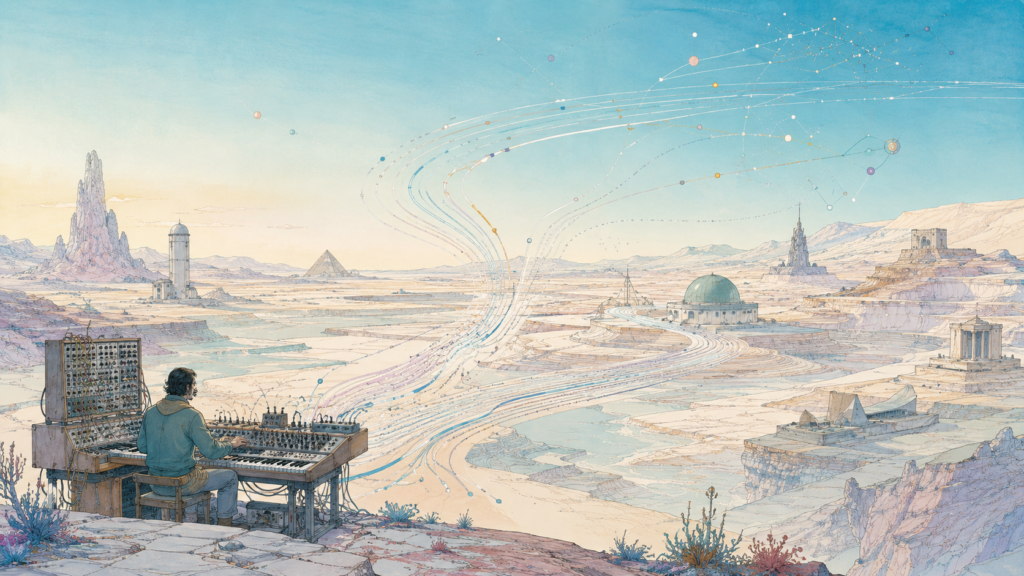
Today I would describe it as a living musical ecosystem: a network of projects, musicians, compositions, technologies and artistic identities that evolve without being forced into permanent line-ups or closed stylistic categories.
This is also how the current Different Lands website presents the project: musicians move across different ensembles and historical phases, while projects can emerge, disappear and return in altered configurations.
The principle holding the system together is not genre.
It is a shared creative gravity.
The musicians involved have come from jazz, progressive rock, electronic music, classical traditions, Mediterranean and Middle Eastern music, experimental composition and improvisation. Their roles have rarely been limited to the conventional functions of a band. They have contributed to a continuously changing musical language based on exchange, contamination and long-term collaboration.
Different Lands is therefore a label, but it is not only a label. It is an infrastructure for musical research.
The early territories
Some of the earliest roots of the catalogue can be found in the work of Advena Avis.
Medioevo Futuro, released in 1997, preceded the formal creation of Different Lands. It was followed by Da Terre Lontanein 2000. These albums combined medieval resonances, contemporary composition, electronic treatments and an interest in musical traditions perceived not as museum objects, but as materials capable of generating new forms.
The year 2000 was a crucial point of convergence.
It saw the publication of my first solo-piano album, Nostalgie di futuro, recorded in 1999, as well as the first album by Terre Differenti. Other projects from that phase included Water Lands, created with Alessandro D’Aloia, and Limbo by Tangram.
Already at that time, the catalogue refused to behave properly.
A solo-piano album could coexist with electronic medievalism, progressive structures, jazz improvisation and cross-cultural experimentation. The label did not search for a market niche and then populate it with similar products. It followed the opposite path: each project had to find the form required by its musical idea.
That choice was artistically liberating and commercially inconvenient.
It was also deliberate.
Terre Differenti and world fusion
Terre Differenti became one of the central projects of this history.
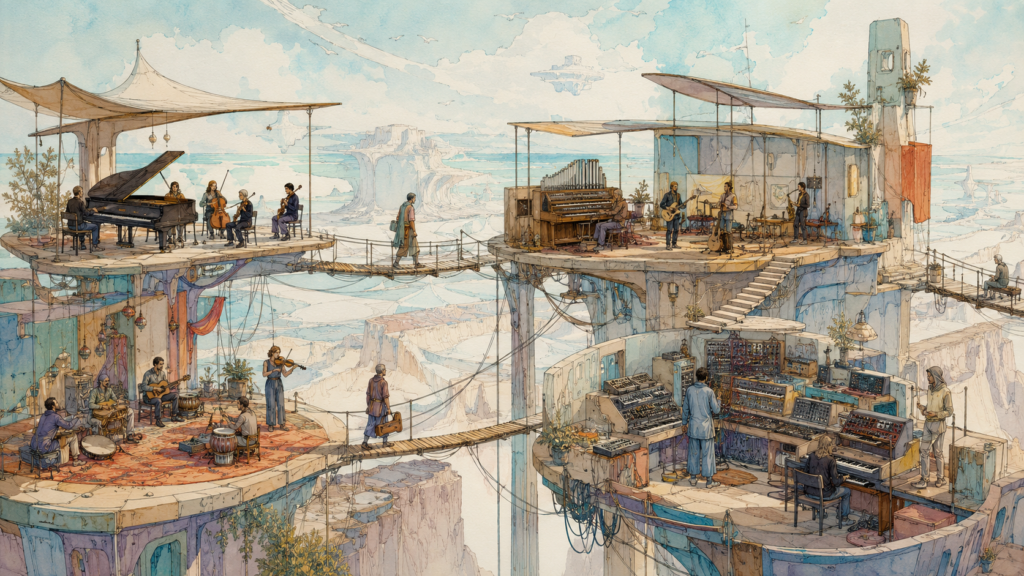
The ensemble was conceived as a meeting space among musicians from different cultural and musical backgrounds. Piano, synthesizers, samplers and electronic instruments interacted with voices, saxophones, flute, clarinet, violin, classical guitar, electric bass and Middle Eastern instruments and percussion.
The purpose was never to decorate Western music with an “ethnic” surface. The aim was to build compositions in which distinct musical languages could modify one another.
The first album, Terre Differenti, was followed by Cities of Dreams in 2005. Later came Odd Times and Eartheart. Across these works, world fusion was treated not as a ready-made genre but as an open compositional problem: how can different rhythmic systems, timbres and cultural memories coexist without being reduced to stereotypes?
This question remains active today.
A new Terre Differenti album, provisionally titled Inner Visions, is now at an advanced stage of production. It will not be an exercise in nostalgia. The intention is to reconnect with the identity of the project while allowing almost three decades of musical, technological and personal experience to reshape it.
Experimental branches and parallel identities
Other projects explored more radical territories.
Pentalogos Group produced Pentalogos and Nicht Mehr für Ohren, works connected with experimental and contemporary musical languages. Tangram moved through progressive, world-fusion and exploratory forms. Otras Tierras, created with Miguel Fernández, developed another dialogue among classical guitar, flamenco-derived elements, electronics and atmospheric composition through albums such as Open Doors and Intentions.
The catalogue also contains projects released under my own name or as Fabio Armani & Guests: Global Village, Visionary Trends, Tracks of Isolation, Surfaces and Essences, Starlight Drifts, Obscure Lights and Simmetrie.
The phrase “& Guests” is significant. It does not indicate the occasional addition of decorative performers to an essentially solitary project. It describes a compositional environment in which the identity of a work is produced through encounters with musicians who introduce their own histories, techniques and sensibilities.
The result is not always stylistically consistent in the conventional sense. But consistency is not the same thing as repetition.
The continuity of Different Lands lies in its method: exploration, hybridization, structural curiosity and resistance to predefined boundaries.
Brave New Worlds
Brave New Worlds represents the progressive-rock branch of the ecosystem, although “progressive rock” is only an approximate definition.
The project combines keyboards, organ, synthesizers, guitars, voices, winds, strings, electronic programming and long-form structures. Its catalogue began with the self-titled Brave New Worlds in 2020 and continued with Net of Illusions, iSignals and aiSongs.
In February 2026, Across was released as a retrospective and recompositional passage through the project’s history.
Brave New Worlds has never been based on the imitation of classic progressive rock. That tradition is present, of course, but it functions as a vocabulary to be questioned and extended. Electronic composition, sound design, artificial voices, asymmetric metres and contemporary production techniques coexist with the historical languages of progressive music.
The next release, KOVRS I, is planned for November 2026. It will be the sixth Brave New Worlds album and a double record devoted to radical reinterpretations rather than conventional cover versions.
The title itself signals the intention: these pieces are not reproduced; they are passed through another musical system.
Nexus Sets and electro-organic composition
Nexus Sets emerged from a different need: to create a stronger integration between electronic structures and performed musical gestures.
Sequencers, synthesizers, programmed processes and hybrid sound design form the architectural basis of the project. Around this electronic nucleus, guitars, violin and other acoustic or electric instruments operate as active, unstable presences.
Nexus Sets I was released in 2023, followed by Malaysian Dream. Two new projects are currently in development.
Drift Cycle is an EP structured as a suite in five movements. Its musical geography moves through plateaus, telluric zones, radiant states, abyssal depths and nocturnal spaces. The work is already in a good stage of production, but I have deliberately avoided assigning it an artificial release date.
Oneiric Planimetry will become the next full Nexus Sets album. Its title suggests the underlying contradiction: attempting to map something as unstable and non-linear as a dream.
Here electronic music is not conceived as the absence of human performance. It becomes an environment in which different forms of intelligence — compositional, instrumental and computational — interact.
Archives are not cemeteries
The twenty-ninth entry in the catalogue has a special status.
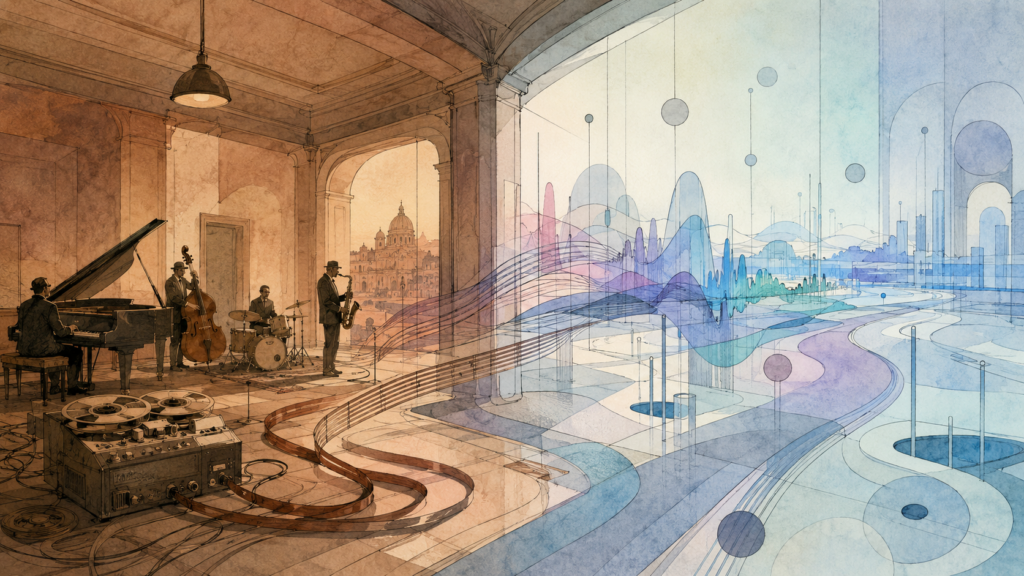
Nostalgia del Futuro, by the Albertini Armani Jazz Quartet, was published in June 2026, but the music had been recorded forty years earlier, in 1986, live in the studio at Forum Studios in Rome.
The album does not carry my individual name but that of the quartet. Its appearance in the catalogue breaks the apparent chronology of the releases and reveals something important: an archive is not necessarily a cemetery of completed events.
A recording can remain silent for decades and later re-enter the present.
When it does, it is no longer exactly the same object. History has changed around it. The musicians have changed. The listener has changed. The technologies of distribution have changed. What was once an undocumented or inaccessible session can become a new publication and acquire an unexpected position within a much larger artistic narrative.
In that sense, Nostalgia del Futuro is almost a manifesto for the entire catalogue. Memory is not the opposite of the future. It is one of the materials from which futures are constructed.
Twenty-nine albums, but no finished map
The new master catalogue currently identifies twenty-nine published albums.
Twenty-one entries have a high level of documentary confidence, while eight still require the verification of some historical metadata: exact release years, original catalogue numbers, primary links or variant titles.
This is not a defect that should be concealed.
Independent musical histories are often fragmented. Old websites disappear, physical editions become difficult to locate, distributors modify metadata and streaming platforms sometimes classify the same work differently. An album may be presented as an EP by one platform and as a full album by its creator. Titles can be altered, capitalized differently or duplicated across later digital editions.
Reconstructing a catalogue therefore becomes an act of historical research.
The current spreadsheet is not intended to impose artificial certainty. Where the evidence is incomplete, the uncertainty is recorded explicitly. Blank fields mean “not yet verified”, not “irrelevant”.
The catalogue should remain a living document, open to corrections and new evidence.
The next territories
The current production pipeline already extends the projected catalogue to number thirty-five.
After KOVRS I, my second solo-piano album, Unwanted Gift, is planned for February 2027. Its concept is already highly developed, and production is progressing.
The title refers to something that arrives without being requested — perhaps a talent, a memory, a responsibility or a condition from which one cannot simply resign. The piano returns here not as a retreat into an earlier identity, but as a radically exposed instrument: no walls of sound behind which to hide, no technological spectacle capable of replacing musical substance.
Other works have intentionally open release dates.
Drift Cycle and Oneiric Planimetry will continue the Nexus Sets trajectory. Amal, created with Abdalla Mohamed, will return to world fusion through a project carrying a particularly strong emotional significance. Inner Visions will mark a major new stage for Terre Differenti.
These albums are not merely items in a production queue. Each one occupies a distinct territory and demands its own time.
A future-oriented catalogue cannot be reduced to a schedule.
Co-creation after the age of the solitary author
The most recent phase of Different Lands is also inseparable from my work with artificial intelligence.
I do not consider AI a substitute for musicians, composers or critical judgement. Nor do I regard it as an autonomous mystical entity endowed with intentions that do not exist.
AI systems are new forms of cognitive and operational mediation. They can contribute to analysis, ideation, research, structural comparison, visual development, documentation and the exploration of alternatives. Their value depends upon the quality of the interaction and upon the human responsibility that directs, verifies and selects the results.
The reconstruction of the Different Lands catalogue itself is an example of this process.
Human memory, physical and digital evidence, online sources and AI-assisted analysis have been combined to produce a more coherent account of twenty-eight years of work. The result is neither the product of an isolated human author nor an automatic machine output. It is a co-created artefact whose reliability still depends on evidence, critical review and explicit decisions.
This approach is becoming increasingly important in my current productions. It does not eliminate authorship. It transforms authorship from solitary command into the orchestration of different intelligences, competencies and forms of agency.
Independence as the freedom to remain unfinished
After twenty-eight years, I do not regard the survival of Different Lands as the simple persistence of a small record label.
Its real achievement is having remained open.
Open to musicians from different cultures and generations. Open to jazz, progressive rock, electronics, world fusion, piano music and experimental forms. Open to old recordings returning from the archives. Open to technologies that did not exist when the label was founded. Open, above all, to the possibility that a musical identity does not have to become fixed in order to become recognizable.
Independence does not mean isolation.
It means retaining the freedom to establish collaborations without allowing the market to determine their meaning. It means publishing music that may not fit a predefined audience. It means accepting discontinuities, dormant periods and unexpected returns.
Different Lands has travelled for twenty-eight years, but it has never reached a definitive destination.
Fortunately.
A land that becomes completely known is no longer a different land.
Fabio Armani
Composer, musician and founder of Different Lands
References
- Different Lands — official website
- Different Lands — musicians and projects
- Fabio Armani — music catalogue
- Terre Differenti — music catalogue
- Nexus Sets — music catalogue
- Different Lands — Master Album Catalogue, updated 21 August 2026