

History of an Idea Always One Step Ahead (and One Step to the Side)
There’s a word that can make eyes sparkle—or roll: utopia.
For some, it’s humanity’s loftiest dream; for others, a synonym for “pie in the sky.”
And yet, when you look closely, utopia is not an escape: it’s a critical tool. It helps measure the gap between what is and what could be.
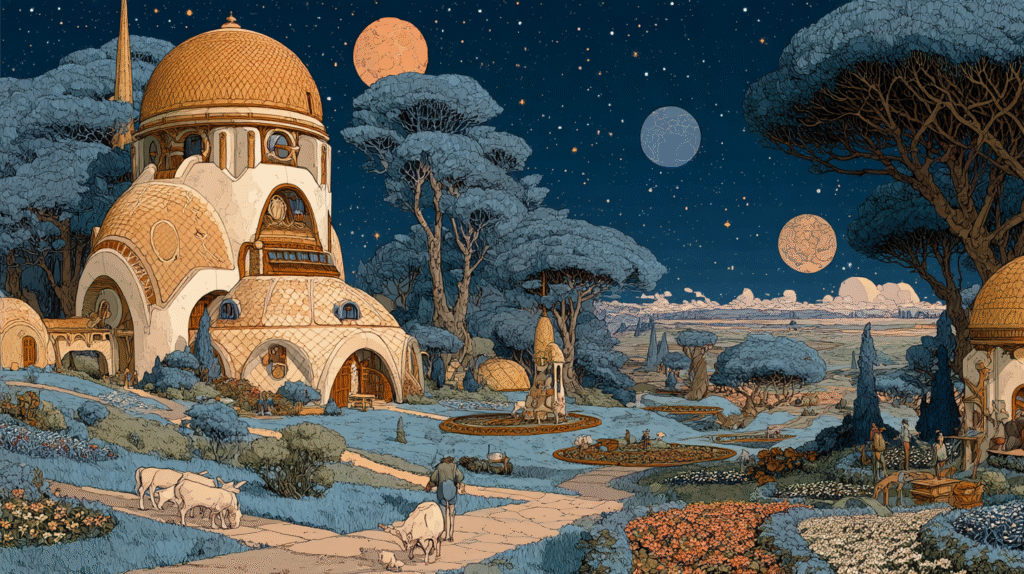
A Definition with a Double Bottom
The term was coined by Thomas More in 1516 with De optimo reipublicae statu, deque nova insula Utopia (printed in Louvain). The etymological play is famous but still brilliant:
- ou-topos = no-place (it doesn’t exist),
- eu-topos = good-place (happy).
The word holds both meanings at once: promise and mirage. User manual included.
A Brief History of Impossible Dreams
(Don’t worry, the dates won’t bite—they’re just there to prevent arguments later.)
- Plato, Republic (ca. 380 BCE, Athens) – A city ruled by philosophers, ordered education, justice as harmony. Noble idea; practical detail: philosophers argue about… everything.
- Thomas More, Utopia (1516, Louvain) – An orderly island, common property, six hours of work a day for everyone (Book II). In 2025 it still sounds shockingly modern.
- Tommaso Campanella, City of the Sun (1602 ms.; pub. Frankfurt 1623) – A circular city, knowledge painted on walls, goods in common. A geometrical utopia written… in prison.
- Francis Bacon, New Atlantis (London 1627, posthumous) – Science as civil foundation (House of Solomon). Less an island than a lab catalog.
👉 From the philosophers’ and Renaissance islands, the dream comes down to earth: no longer exotic “elsewheres,” but concrete social projects in Europe’s industrial reality.
- Charles Fourier, Théorie des quatre mouvements (Paris 1808) – The phalansteries: cooperative communities where “passional attraction” guides work. Do what you love and work stops being alienating (LinkedIn would have cheered).
- Robert Owen – New Lanark (Scotland, 1800–1825) and New Harmony (Indiana, 1825–1827) – An industrial philanthropist who actually reformed things: schooling for workers’ children, fair shops, decent housing. The communities didn’t last long, but left tangible legacies.
- Étienne Cabet, Voyage en Icarie (Paris 1840) – A novel-project that inspired Icarian communities (Illinois and Texas, from 1848). Life was tough; the name remained poetic.
Between the 19th and 20th centuries, the dream shifted gears: from imaginary islands to political programs. With Marx and Engels (Communist Manifesto, 1848; Das Kapital, 1867), utopia stopped talking only about phalansteries or Icarias and presented itself as “scientific” (their term). No longer small experimental communities, but the promise of a global transformation of society.
Workers’ parties, unions, cooperatives, and internationalist movements sprang up: hope organized itself, held assemblies, drafted statutes. (And yes, they argued too: dialectics wasn’t just a philosophical method, it was a daily habit.) From this point on, for better and for worse, utopia got its hands dirty with real history.
In the 20th Century: Fields and Cooperation
- Kibbutzim in Israel (from 1910): common production, shared education, social experimentation.
- Anarchist collectives in Spain (1936–1939): self-management during civil war.
- Auroville in India (1968): Mirra Alfassa’s “universal city,” still alive (and imperfect, like all living things).
👉 If the 20th century built physical communities—often rural and cooperative—the 21st century shifts the focus to bits: networks, open source, platforms, virtual realities. The place of the dream changes, not the impulse.
Contemporary Utopias (Quick User’s Guide)
- Technological – Silicon Valley’s “we’ll change the world” version (often translatable as: “we’ll change your datainto profit”).
- Ecological – Low-impact communities, selective degrowth, local infrastructures.
- Digital – Open source, DAOs, online commons, participatory democracy (with the eternal question: who moderates the moderators?).
Concrete example? Decidim, the open-source platform born in Barcelona in 2016, now used by dozens of European cities to let citizens vote on budgets, parks, bike lanes (basically: the small but mighty urban civil wars). Then there are DAOs, self-governing blockchain communities that feel ripped from a cyberpunk manual, and digital commons like Wikipedia, where millions cooperate for free to endlessly fix the same comma. Paradise? Hardly. But it’s already utopia in beta release.
- Political – Visions of just and peaceful societies: from Marx (Das Kapital, 1867) to Bloch (Das Prinzip Hoffnung, 1954–59), up to today’s post-capitalist proposals.
💬 Hook to the reader
Can you picture yourself in a phalanstery, where your neighbors decide when to knead the bread and when to pick the tomatoes?
And if Fourier had had Facebook, he’d have started the group: “Passion Papillon – let’s swap jobs so we don’t get bored.” How many likes?
🔲 Box 1 – Utopia vs. Dystopia
Utopia designs a desirable society; dystopia shows what happens when the dream hardens into control.
- Utopia: More (six-hour workday), Campanella (solar city), Fourier (cooperation).
- Dystopia: Huxley (Brave New World, 1932) – chemical happiness; Orwell (1984, 1949) – total surveillance.
Same drawing board, opposite outcomes.
Utopia or Dystopia? (The Thin Line)
Every perfect project casts a shadow. One “it’s for your own good” and the dream becomes a fence.
Here, Ernst Bloch helps: utopia as an anticipatory consciousness, an energy that projects into the future what is missing in the present; not a closed blueprint, but an open tension.
And then the brake: John Gray (Black Mass, 2007) reminds us that salvific projects can degenerate into totalitarian ideologies. Dream yes, but with the critical dial turned on.
🔲 Box 2 – Real Experiments (Quick Notes)
- Kibbutzim (since 1910): agricultural cooperation; evolving into hybrid models today.
- Spanish collectives (1936–39): self-management during war; cut short but historically crucial.
- Mondragón (1956, Basque Country): the world’s largest worker cooperative, with thousands of worker-members; a hybrid model of enterprise and community, still active.
- Auroville (1968–today): a living “universal city,” with tensions and real-world lessons.
📎 For the XXL version (complete timeline, case studies, extended bibliography): [link to academic article in 3 parts]
Why Do We Still Need Utopia?
Because it’s a compass: not a point reached, but a direction.
Because without it, all we’re left with are talk shows—and there, the gap between reality and farce is… utopically small.
Because, as Bloch reminds us, the “principle of hope” is not escapism but a transformative push.
💬 Another hook
When More imagined the six-hour workday, he wasn’t thinking of Change.org; yet if the petition circulated today, it might break the record for signatures.
Mini Essential Bibliography
- Plato, Republic, ca. 380 BCE, Athens.
- Thomas More, Utopia, 1516, Louvain (six-hour workday, Book II).
- Tommaso Campanella, City of the Sun, 1602 ms.; pub. Frankfurt 1623.
- Francis Bacon, New Atlantis, London 1627 (posthumous).
- Charles Fourier, Théorie des quatre mouvements, Paris 1808 (passional attraction, phalansteries).
- Robert Owen, Report to the County of Lanark, 1820; experiments at New Lanark and New Harmony (1825–27).
- Étienne Cabet, Voyage en Icarie, Paris 1840; Icarian communities in the USA (from 1848).
- Karl Marx, Das Kapital, Hamburg 1867.
- Aldous Huxley, Brave New World, London 1932.
- George Orwell, 1984, London 1949.
- Ernst Bloch, Das Prinzip Hoffnung, Frankfurt 1954–1959.
- John Gray, Black Mass: Apocalyptic Religion and the Death of Utopia, London 2007.
- Erik Olin Wright, Envisioning Real Utopias, London–New York 2010.
- Rutger Bregman, Utopia for Realists, Amsterdam 2016.
📝 Author’s Note
This article is part of the Utopia Cluster of OpenLogos, a path exploring the dream as a critical tool for social transformation.
Other cluster elements:
- Narrative – The Song of the Seven Shadows: a symbolic tale set in ancient Uruk-Nera, on the origins of collective longing for justice.
- Academic article (in three parts) – History and theory of utopia, with a timeline of real experiments and extended bibliography.
- ANARRESS – A hybrid, experimental text (anagram/analysis) that dismantles and reassembles the very idea of utopia to reveal its cognitive biases and political potential.
👉 This popular piece is the light entry gate: those who want to dig deeper will find in the Cluster narrative paths, structured essays, and critical thought experiments.