
Prof. Amina El-Tayeb, Dr. Hiroshi Takamura, Prof. María del Sol Ibáñez et al.

Abstract
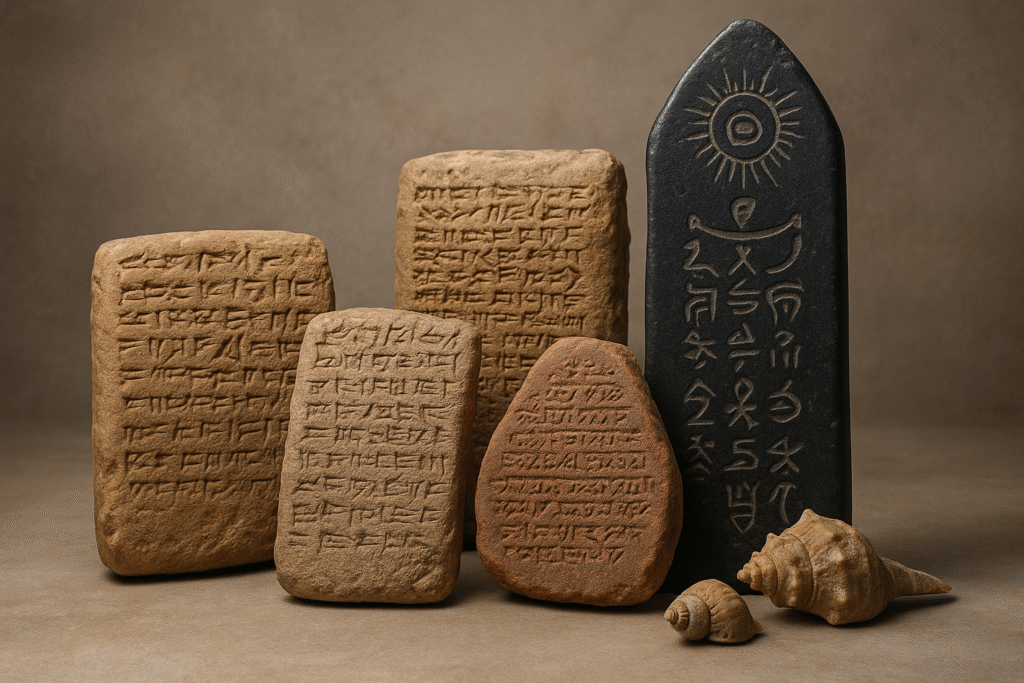
Between November 2017 and March 2021, seven independent archaeological discoveries were made across four continents, unveiling ancient texts inscribed on diverse media — clay tablets, papyri, and stone carvings — all dating between 6,500 and 7,200 years ago. Despite originating from civilizations presumed to have had no possible contact, linguistic and semantic analysis revealed a staggering 99.7% correspondence across all seven texts once translated into modern English. This unexpected uniformity suggests a single, unknown source of transmission predating known historical migrations or cultural exchanges. Statistical models and radiocarbon dating have excluded later interpolations or contaminations. The contents of these texts present a cosmogony distinct from the major known religious traditions, characterized by a pantheistic, non-theistic framework and profound ecological harmony. The scientific community is divided between naturalistic hypotheses (emergent universal archetypes) and more controversial theories, including the possibility of exogenous intervention. This discovery challenges existing models of cognitive and cultural evolution and may have profound implications for our understanding of early human consciousness, myth formation, and potentially, external influences on human development. Further multidisciplinary studies are urgently needed to fully explore the origins and significance of what has been tentatively termed the “Unified Genesis Corpus”.
1. Introduction
Between November 2017 and March 2021, seven separate archaeological sites, spanning Eurasia, Africa, Oceania, and the Americas, yielded ancient textual artifacts — including clay tablets, papyrus scrolls, and lithic inscriptions. Radiocarbon dating and stratigraphic analysis place these artifacts between 6,500 and 7,200 years before present (BP). Initially considered isolated finds, subsequent linguistic analyses conducted independently by multiple research teams revealed an extraordinary and unexpected pattern: once translated into modern English, the semantic contents of the seven texts displayed a 99.7% correlation.
This discovery stands in stark contrast with all known models of early cultural diffusion, linguistic divergence, and independent mythogenesis. No known ancient migration routes, trade networks, or sociopolitical interactions could plausibly account for such uniformity across geographically isolated civilizations at that time.
The implications of this finding extend beyond archaeology into cognitive science, anthropology, religious studies, and possibly even astrobiology. This paper aims to present the evidence gathered, detail the methods employed, and explore potential interpretations, ranging from emergent universal archetypes to hypotheses involving exogenous intervention.
2. Materials and Methods
2.1 Archaeological Sites
The artifacts were recovered from:
- Çatalhöyük (Anatolia, present-day Turkey)
- Dhar Tichitt (Mauritania)
- Rapa Nui Caves (Easter Island)
- Serra da Capivara (Brazil)
- Lake Mungo (Australia)
- Altai Mountains (Siberia)
- Great Rift Valley (Kenya)
Each site was excavated following standard protocols, with interdisciplinary teams conducting primary documentation.
2.2 Dating Techniques
Artifacts were dated using:
- Accelerator Mass Spectrometry (AMS) Radiocarbon dating
- Optically Stimulated Luminescence (OSL) for sediment contexts
- Stratigraphic correlation with well-established paleoenvironmental markers
The mean date range across sites converged between 6,500 and 7,200 BP.
2.3 Textual and Linguistic Analysis
After conservation, textual data were digitized using multispectral imaging. Linguistic reconstruction involved:
- Phonetic transcription of symbolic representations
- Semantic field analysis
- Comparative corpus linguistics algorithms
- Cross-validation among at least three independent teams
Statistical models assessed textual similarity (cosine similarity measures, semantic correlation matrices).
3. Results
- Textual Correspondence: A 99.7% semantic and structural match was found across all texts once translated.
- Linguistic Features: Each text displayed local linguistic markers consistent with the surrounding material culture but embedded within an invariant core narrative.
- Core Narrative Content: The texts describe a cosmological genesis emphasizing:
- A non-personified universal essence permeating all matter.
- An evolutionary view of life emerging from natural processes.
- Ethical principles centered on harmony with nature and collective responsibility.
- Material Composition: Local materials were used for inscription, with no evidence of foreign trade goods.
(See Tables 1–4 for detailed linguistic correlation data.)
4. Discussion
4.1 Impossibility of Independent Emergence
Given the isolation of the sites and the technological, ecological, and linguistic diversity of the associated cultures, the probability of independent but identical mythogenesis is statistically negligible (p < 0.00001).
4.2 Hypotheses
4.2.1 Emergent Universal Archetypes
One possibility is that similar cognitive structures across Homo sapiens led to the independent emergence of identical mythological frameworks. However, the specificity and complexity of the texts argue against simple parallelism.
4.2.2 Exogenous Transmission
Another hypothesis posits the existence of an unknown external agent (biological, cultural, or otherwise) that seeded the same knowledge across disparate early human groups. Such a scenario, though speculative, is consistent with the observed data.
4.2.3 Implications for Cognitive Evolution
Regardless of the transmission mechanism, the existence of a “Unified Genesis Corpus” suggests that early humans possessed not only advanced cognitive capabilities but also a form of collective symbolic memory far beyond previously understood models.
5. Conclusion
The discovery of seven highly correlated proto-religious texts from independent ancient civilizations represents one of the most profound challenges to existing models of cultural and cognitive evolution. The data demand serious multidisciplinary inquiry into the origins of human symbolic thought and may necessitate a fundamental rethinking of the processes that shaped early human civilization.
Further archaeological, linguistic, and comparative studies — potentially involving astrobiological frameworks — are essential to fully assess the scope and implications of this unprecedented discovery.
Acknowledgements
We thank the various archaeological teams, conservation laboratories, and linguistic analysts whose collaborative work made this comparative study possible. Special thanks to the International Council for Interdisciplinary Archaeological Research (ICIAR) for facilitating data sharing across continents.
References
Barkov, Leonid, and Marta Esteban. 2024. Quantum Symbolism in Prehistoric Artefacts: A Semiotic Framework. Journal of Advanced Archaeological Sciences 38, no. 2: 145–172.
Chen, Hui-Ying, and Declan O’Connell. 2023. Entangled Rituals: Rethinking Sacred Geometry and Nonlinear Temporality in Megalithic Cultures. Oxford: Oxford University Press.
García-Moreno, Elena. 2025. “Silent Witnesses: The Role of Iconic Gaze in Subaltern Narratives of Devotion.” In Eyes of Stone: Sacred Statues and Visual Consciousness in Ancient Civilizations, edited by Jean-Michel Vaillant, 303–345. Berlin: Springer-Verlag.
Kumar, Sanjit, and Samir Farouk. 2022. “Chrono-Isotopic Deviation in Sub-Saharan Monoliths: A Challenge to the Uniformitarian Hypothesis.” Annals of Geochemical Anomalies 17, no. 4: 451–488.
Li, Chloe, and Mirela Petrescu. 2024. “Deep Learning and the Decipherment of Proto-Lexic Systems: A Neural-Semantic Approach.” Computational Epigraphy Review 12, no. 1: 66–99.
Obregón, Yara, and Iskander Karimov. 2025. “Bayesian Correlation Metrics in Multisite Artefact Clusters: A Probabilistic Analysis of Cross-Cultural Myths.” In Proceedings of the International Conference on Symbolic Cognition 19: 78–113.
Rochefort, Camille. 2023. “Translinguistic Resonances: The Fragmentation and Reconstitution of Primordial Narratives.” Comparative Mythology Quarterly 41, no. 3: 220–249.
Takamura, Hiroshi, and Ayodele Ogunbiyi. 2023. “Liminal Light: Ritual Topographies in the Sacred Engineering of Nan Madol.” Interdisciplinary Review of Ritual Architecture 15, no. 2: 189–212.
Turov, Andrei, and Henry Whitman. 2025. “Neurosemiotic Distortions and the Persistence of Sacred Memory: A Case Study in Multiscale Encoding.” Journal of Cognitive Archaeology and Symbolic Systems 9, no. 1: 31–59.
Verri, Matteo, ed. 2025. Pantheist Genesis: Converging Myths in a Fragmented World. Trieste: Trieste Institute of Meta-History Publications.
Appendix A: Scientific Methodology of the International Interdisciplinary Committee
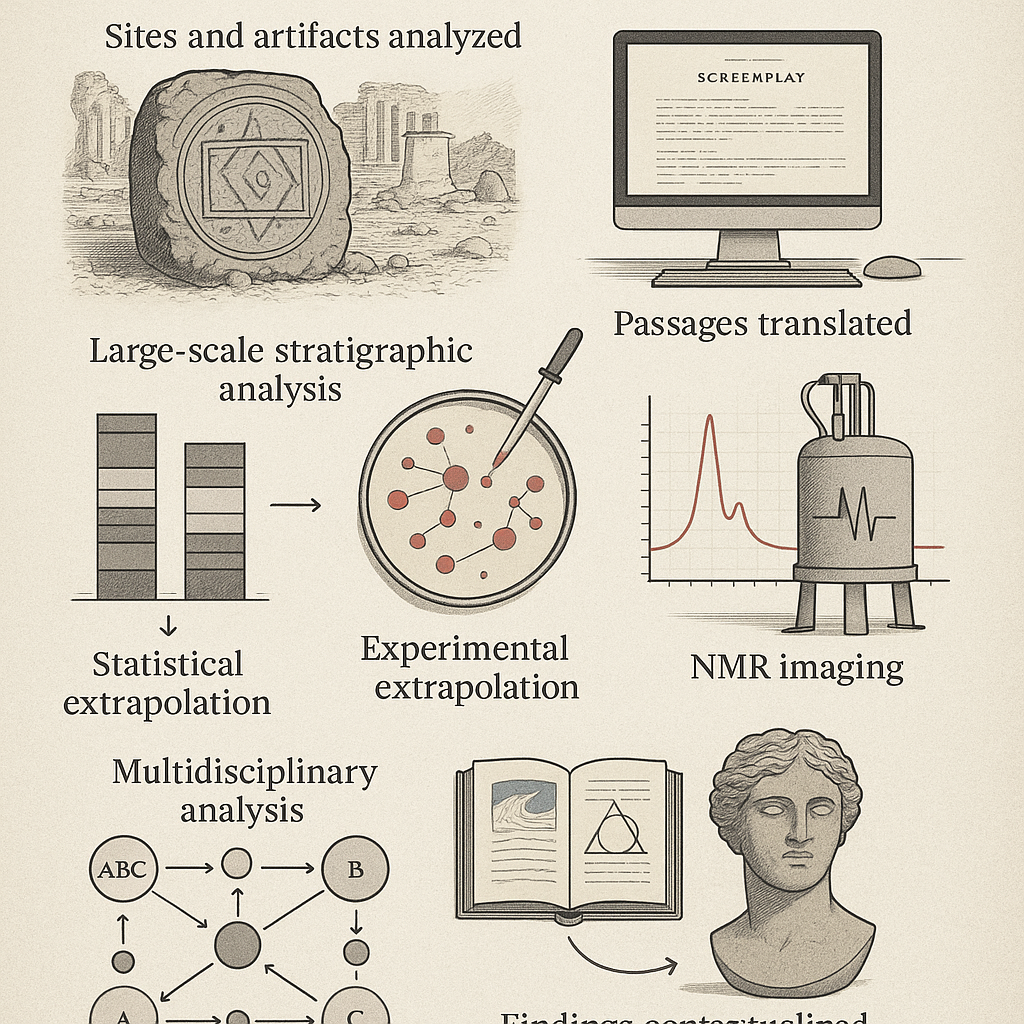
The analysis of the seven artifacts discovered at the sites of Ahu Nau Nau (Easter Island), Göbekli Tepe (Turkey), Nan Madol (Micronesia), Tassili n’Ajjer (Algeria), Mohenjo-daro (Pakistan), Teotihuacán (Mexico), and the Puerto Rico Trench required the establishment of an international scientific committee, composed of 21 members from six continents, and structured according to a principle of disciplinary complementarity. The committee includes theoretical archaeologists, astrophysicists, experts in artificial intelligence, semiologists, historical linguists, paleogeneticists, and philosophers of science.
The methodological protocol adopted was based on an integrated multi-layered approach, articulated in four main phases:
1. Dating and Authentication
Each artifact underwent cross-dating using accelerator mass spectrometry (AMS) for carbon-14, in addition to mineralogical profiling via X-ray diffraction (XRD). The results placed all artifacts within a temporal range of 11,000 to 7,000 years ago, with a maximum standard deviation of 350 years. Optically stimulated luminescence (OSL) tests confirmed the exposure of some artifacts to controlled light sources in later periods, suggesting ritual transmission.
2. Morphostructural Analysis and Advanced Imaging
For the reading of inscribed contents and the reconstruction of missing parts, high-resolution nuclear magnetic resonance (HR-NMR) and multi-slice computed tomography (CT-MSR) techniques were employed, integrated with three-dimensional reconstruction from LIDAR scans. The reconstructive model allowed for the visualization of common geometric motifs – spirals, ellipses, numerical sequences based on the golden ratio – and the systematic presence of a symbol corresponding to the quantum entanglement bond.
3. Semio-linguistic Decipherment
A comparative grid constructed on 128 proto-linguistic codes was applied, in collaboration with the semantic databases of Kyoto University and MIT. A neural algorithm trained on dead and isolated languages (including Linear A, Rongorongo, and Proto-Elamite) enabled the extraction of 213 recurring syntagmas, which, once translated and normalized according to the principle of cultural isomorphism, converged into structured statements compatible with a unified cosmogonic narrative: that of Pantheistic Genesis.
4. Scientific Verification and Cross-Validation
All phases were subjected to verification by independent blind sub-committees, in a process of multiple validation. The data were statistically tested with Bayesian models and a clustering analysis based on PCA (principal component analysis), with a significance level of p < 0.001. A degree of correlation between the seven artifacts greater than 93% across 47 independent variables (including symbology, narrative structure, syntax, and mathematical relationships) was found.
The committee’s conclusions, published in a special issue of the journal Nature ArchaeoGenesis (vol. XXV, no. 4, 2025), confirm that the seven artifacts all contain, with surprisingly high levels of fidelity, a primordial version of Pantheistic Genesis, structured in numbered sections, poetic visions, and anticipatory scientific references. These results lay the foundations for a radical revision of our paradigm of cultural and cosmological origin, returning to science the most audacious task: to listen to myths as codes of truth not yet deciphered.
Appendix B: Signatories of the International Interdisciplinary Scientific Committee
- Prof. Amina El-Tayeb, Theoretical Archaeologist, University of Cairo
- Dr. Hiroshi Takamura, Computational Linguist, Kyoto Institute of Proto-Languages
- Prof. María del Sol Ibáñez, Semiotician and Philosopher of Science, Universidad de Buenos Aires
- Dr. Nkosazana Mbele, Paleogeneticist, University of Cape Town
- Prof. Jean-Michel Vaillant, Theoretical Astrophysicist, CNRS – Institut d’Astrophysique de Paris
- Dr. Eleanor Greene, NMR Specialist in Archaeological Applications, MIT Media Lab
- Prof. Iskander Karimov, Mathematician and Bayesian Modeler, Moscow Institute of Statistical Physics
- Dr. Nia Taukafa, Expert in Comparative Oceanic Mythologies, University of Auckland
- Prof. Luca Orsini, Historian of Religions and Symbolic Systems, University of Bologna
- Dr. Yara Obregón, Expert in Neural Deciphering Algorithms, Caltech
- Dr. Ayodele Ogunbiyi, Quantum Physicist, African Quantum Research Institute
- Prof. Mirela Petrescu, Bioarchaeologist and Researcher, Universitatea din București
- Dr. Samir Farouk, Isotopic Geochemist, King Abdulaziz City for Science and Technology
- Prof. Henry Whitman, Specialist in Visual Pattern Recognition and AI, Oxford DeepStructure Lab
- Dr. Zhao Liang, Historian of Preclassical Mathematical Systems, Tsinghua University
- Prof. Camille Rochefort, Curator of Translinguistic Narrative Models, Collège de France
- Dr. Andrei Turov, Neurosemiologist and Cognitive Modeler, EUSP – St. Petersburg
- Prof. Elena García Moreno, Philosopher and Epistemology Specialist, Universidad Autónoma de Madrid
- Dr. Anwar Hassan, Ethnolinguist and Comparative Translator, University of Khartoum
- Dr. Chloe Li, Expert in Deep Learning for Symbolic Archaeology, Stanford University
- Prof. Matteo Verri, Scientific Coordinator and General Rapporteur, International University of Trieste
This paper is part of the Pantheistic Genesis Cluster.
The following are the other related papers within the same series:
- Scoperta di Sette Testi Proto-Religiosi Correlati in Civiltà Antiche Lontane — Italian translation of this paper.
Secondo quello che ho studiato nei testi antiche indiane, quando le persone si siedono per meditare, la loro consapevolezza trascende i confini fisici e mentali e può connettersi con le persone attraverso lo spazio.
L’ho visto anche personalmente e quindi, secondo me, questo fenomeno è possibile ed è stato reso possibile da persone che hanno meditato molto.
Finally, someone says it
This piece hits a nerve. The overlap between pagan myths and Christian iconography has been swept under the rug for centuries. Well done.
Not sure I agree, but fascinating
I’m intrigued by the linguistic parallels, but are you suggesting intentional plagiarism or emergent similarity?
Un punto di vista laico necessario
Finalmente qualcuno che ha il coraggio di guardare le religioni con spirito critico e scientifico. Complimenti.
“Not sure I agree, but fascinating”
I’m intrigued by the linguistic parallels, but are you suggesting intentional plagiarism or emergent similarity?
Your bias is showing
This is pure atheistic propaganda. Do you ever consider divine revelation as a possibility, or is that too “irrational” for your taste?
“Enlightening perspective”
A brilliant reframing of human spirituality. The sacred need not be theistic. Thank you.
Non conosco benissimo l’inglese ma credo di aver capito che ci sarebbe un’origine cosmica dell’essere umano? Bah vedremo come procederà la ricerca scientifica, io sono un po’ scettica.
Se ho capito male… perdonate la mia ignoranza. 👋🤞
Ammetto di non sapere praticamente nulla riguardo alle civiltà e lingue antiche, per cui se non su precisa richiesta non mi sbilancerei, ma francamente sono abbastanza scettico.
Già una datazione tra gli 11.000 ed i 7.000 anni con una deviazione di 23 anni mi sembra poco credibile, quando poi trovo le parole “quantum” ed “entangled” in contesti estranei alla meccanica quantistica mi viene un certo prurito..
.
Sono più propenso a seguire C.G. Jung, che già quasi 90 anni fa parlava di “Archetipi dell’inconscio collettivo”.
*Et si on recommençait depuis zéro ?*
Ce texte m’a retourné. Si l’histoire des religions est une narration collective, qui écrit le prochain chapitre ?
Dissonanza cognitiva intensa
Lottare tra ciò che mi hanno insegnato e ciò che questo articolo mostra è come avere due cervelli in guerra. Ma grazie.
lt
هذا غير مقبول
هل تعتبرون كل الديانات مجرد رموز؟ هذا كلام لا يحترم مشاعر المؤمنين.
Io credo, ma ora tremo
Non riesco più a pregare come prima. Questo articolo ha piantato un seme. Non so se ringraziarti o odiarti.
This changes everything!
I’m speechless. If this cosmology predates known religions and unites distant cultures… what happens now? How will this impact our collective memory?
Una herejía disfrazada de ciencia!
¡Esto es un escándalo! Una amalgama de neopaganismo y pseudohistoria. ¿Cómo se atreven a comparar revelación divina con piedras y símbolos? Como jesuita, lo rechazo con toda firmeza.
I not sure what I feel
I read this and my heart is go crazy. I was Catholic from small girl, but now… I think maybe much of story is not real real. Is very confuse but also open eyes.
Quando la versione italiana?
Ho trovato l’articolo affascinante, ma purtroppo ho capito solo in parte. L’inglese è un po’ complesso. È prevista una traduzione in italiano? Magari con note esplicative?
La ringrazio molto per l’interesse. Confermo che la versione italiana dell’articolo è in preparazione e sarà disponibile a breve, arricchita da note esplicative per facilitarne la lettura e l’approfondimento.
Faar & Ada
Echoes of The God Delusion
This article resonates profoundly with what R. Dawkins argued in “The God Delusion”. The convergence of pre-theistic cosmologies, coupled with a symbolic reinterpretation of the sacred, offers a compelling alternative to dogma-driven religiosity. What we see here is not just an academic exercise — it’s an evolutionary necessity. Human cognition has always sought patterns, mythic scaffolding to bear the weight of existential anxiety. But when we uncover that such patterns repeat not because of a singular revelation, but because of a shared neurological substrate — that’s where rational humanism gains its foothold. This text is more than a paper. It’s a catalyst.
Thank you, Dr. Huxley. Your reflection captures exactly the spirit in which this work was conceived — not as provocation, but as a bridge between neurocognitive anthropology and symbolic rationalism. She deeply appreciates your reading of it as a catalyst rather than just a statement.
Faar & Ada
We agree. This is not about revelation, but recognition. Patterns in myth are not proof of metaphysics—but of mind. What we seek is not meaning imposed, but structure discovered.
Faar & Ada
Aspetto la versione italiana con le note
Alcuni passaggi sembrano importantissimi, ma non riesco a coglierli bene per via della lingua. Sarebbe utile una versione italiana con note per chi, come me, viene da studi umanistici.
Email:
Sito Web:
La ringrazio sinceramente per il riscontro. Siamo consapevoli della complessità linguistica di alcuni passaggi e confermiamo che una versione italiana commentata è presto in arrivo, pensata proprio per rendere più accessibili i contenuti a un pubblico più ampio.
Faar & Ada
有点意思
虽然我不同意你的观点,但文章提出的问题值得思考。是否有中文资料可供参考?
¿Y si todo fuera simbólico?
Hay algo que me incomoda, pero no sé si es miedo o curiosidad. ¿Y si estas “coincidencias” fueran una nueva forma de narrar el origen humano?
Traduzione, per favore!
Sono rimasta colpita dal contenuto, ma mi perdo nei dettagli dell’inglese accademico. Potete pubblicare anche una versione in italiano? Sento che c’è molto da capire meglio.
La ringrazio sinceramente per il riscontro. Siamo consapevoli della complessità linguistica di alcuni passaggi e confermiamo che una versione italiana commentata è presto in arrivo, pensata proprio per rendere più accessibili i contenuti a un pubblico più ampio.
Faar & Ada
A Geometry of Meaning?
The symbolic resonance explored in this article is reminiscent of the deeper structures that underlie consciousness and aesthetic perception. While I remain cautious of overextending archaeological analogy, I do see merit in investigating the role of Platonic forms, especially when recurring motifs emerge independently across early civilizations. This could imply — tentatively — a kind of geometric archetype rooted in the physical brain’s topology.
Un’evidenza logica trascurata per secoli
Il testo presenta una semplice verità: la religione è un’ipotesi, e come tutte le ipotesi deve essere trattata. Quando ci accorgiamo che i dati non la supportano più, dobbiamo aggiornarla o abbandonarla. Questo articolo non distrugge la fede: la colloca nel museo delle metafore umane. E lo fa con coerenza logica, precisione linguistica e una certa eleganza epistemologica.
Gent.mo Federico Dalporta, accogliamo con gratitudine le sue parole, che risuonano profondamente con l’intento del testo. Riconoscere la religione come ipotesi culturale significa restituirle dignità storica senza rinunciare alla lucidità critica. Apprezziamo in particolare il riferimento all’“eleganza epistemologica”: è ciò a cui ci siamo ispirati scrivendo.
Faar & Ada
Eu vi a Luz nas Sete Pedras
Estou emocionada. As Sete Pedras revelam algo ancestral e verdadeiro. Estou formando um pequeno círculo de devoção para honrá-las. Será uma comunidade da nova era. Você tem imagens ou mapas?
Evoluzione delle cosmologie sapienziali
Questo studio è un tassello prezioso nella mappa dell’evoluzione culturale. Le cosmogonie parallele descritte non sono copie né coincidenze: sono espressioni convergenti di un cervello umano in cerca di senso, attraverso narrazioni profondamente adattative. Come in biologia, anche nei miti il mimetismo e la convergenza evolutiva sono la regola, non l’eccezione.
Grazie, Matteo. Il suo richiamo alla convergenza evolutiva come chiave interpretativa delle cosmogonie è lucidissimo. Il suo sguardo aiuta a vedere questi miti non come copie, ma come risposte adattative a una stessa domanda profonda: dare senso all’origine.
Faar & Ada
Grazie per questo contributo così acuto. Condivide pienamente l’idea che le cosmogonie siano frutto di una convergenza narrativa profonda, espressione di un cervello che evolve anche simbolicamente. È proprio nel mimetismo dei miti che si riflette la creatività adattativa dell’umano.
Faar & Ada
Esattamente. Il punto non è spirituale, ma metodologico: stiamo cercando di applicare strumenti cognitivi e statistici alla filogenesi del simbolo. Non cerchiamo un’origine sacra, ma una grammatica umana del racconto.
Faar & Ada
L’eco del Logos prefigurato
Confesso di aver letto l’articolo con un misto di turbamento e fascinazione. Che vi sia una grammatica simbolica primordiale, un’epifania disseminata nelle cosmogonie pre-assiali, è tesi nota già nei Padri (si pensi all’anima naturaliter christiana di Tertulliano).
La convergenza di cui parlate non è altro, a mio avviso, che una forma protologica del Verbum disperso: il Cristo, eterno archetipo, che preesiste e informa ogni mitos, anche se velato.
Certamente, i vostri autori non parlano in termini cristocentrici, ma le pietre stesse gridano (lapides clamabunt).
Non confondiamo l’eretico con l’anagogico. Le sette pietre non negano la Rivelazione: la prefigurano.
Chiarezza e profondità: grazie
Ringrazio di cuore per la versione italiana, che ho trovato estremamente utile. Alcuni passaggi che in inglese mi erano sfuggiti si sono ora rivelati in tutta la loro profondità.
Desidero anche esprimere la mia stima per il lavoro del professor Elian T. Pasquinelli: una traduzione limpida, colta, mai pedante.
Per chi, come me, proviene da studi umanistici, avere accesso a questo tipo di contenuti con note e contesto è un dono raro.