
AETHER
Ontology of a Sonic Field
Over the past centuries Western music has constructed an extremely sophisticated system.
A system grounded on a few fundamental axes: rhythm, harmony, melody, development.
But above all on a nearly invisible assumption: gesture.
Music has traditionally been conceived as a human gesture organized in time.
A gesture that takes form through instruments, performers, and performance.
The musician performs an act.
The listener perceives it.
Between the two an expressive relationship is established.
The AETHER project begins with a very simple — and at the same time radical — question:
What remains of music when gesture disappears?
Subtracting the Gesture
In the contemporary world, music has become increasingly visible. Concerts, performances, streaming, artistic identities, biographical narratives. Gesture has become not merely an element of music, but often its symbolic center.
The AETHER project attempts the opposite movement.
Not to add. To subtract.
To subtract:
- performance
- narration
- the centrality of the performer
- the rhetoric of individual expression
Not to impoverish music, but to observe what happens when it ceases to be gesture and becomes field.
Music as Field
The working hypothesis of AETHER is that music can be conceived not as a sequence of events, but as a spatial condition.
No longer a structured temporal sequence, but an environment.
In this context:
- rhythm disappears
- melody does not exist
- harmony does not develop narrative tension
Sound does not lead from one point to another.
It inhabits a space.
Time is no longer dramaturgical.
It becomes stratigraphic.
As in a geological landscape, layers do not “happen”: they coexist.
Not to impoverish music, but to observe what happens when it ceases to be gesture and becomes field.
A Genealogy of the Sonic Field
The idea of a music that renounces gesture did not arise in a vacuum.
In the second half of the twentieth century several composers began questioning the very notion of music as event.
La Monte Young was among the first to imagine sound as pure duration.
His continuous drone works — often extending for hours — transform music into an almost motionless perceptual field.
Morton Feldman, with his extremely long and sparse compositions, explored a suspended musical time devoid of narrative development.
In Feldman, sound does not construct discourse: it exists as a fragile temporal surface.
Éliane Radigue, in her electronic works and monumental drone pieces, pushed this idea to its limits.
Sound becomes an extremely slow process, an almost imperceptible transformation of sonic matter.
Finally, Brian Eno introduced into contemporary language the concept of ambient music: music capable of functioning as environment, as a perceptual space that does not require narrative attention.
The AETHER project situates itself within this constellation of experiences, but pushes subtraction even further.
Not only eliminating musical development, but reducing to a minimum the very notion of artistic gesture.
Phenomenological Field
In philosophy, the term phenomenological field indicates the space in which experience appears to consciousness.
Not an isolated object, but a configuration of perceptual relations.
Applied to sound, this concept suggests a different perspective on music.
Sound is no longer an event happening before us.
It becomes a perceptual field in which we are immersed.
The AETHER project explicitly adopts this perspective.
Music is not conceived as a sequence of actions, but as a phenomenological environment.
The Ontology of AETHER
To describe this structure it became necessary to modify language itself.
AETHER is not a band.
It is not an ensemble in the traditional sense.
It is an operational field.
The individuals participating in the project are not musicians in the conventional sense.
They are Field Operators.
Their role is not to perform a gesture, but to configure a sonic condition.
They do not interpret.
They operate on the field.
The Field Operators

In the first cycle of the project three configurations operate.
Not biographical identities.
Not artists in the traditional sense.
Rather operational codes.
EON
Configuration of the fundamental field.
Drone architecture, static harmonic space, continuity of the sonic plane.
EON establishes the substrate upon which the field can exist.

KAE
Operations of timbral modulation.
Sound layers emerge and dissolve within the field without ever transforming into gesture.
KAE operates in the intermediate region of the field.
NYR
Structures of dissolution.
Subtle elements that modify the perception of density: filaments, harmonics, spectral residues.
NYR operates at the margins of the field.

The Negation of Performance
One of the implicit principles of AETHER is the negation of performance.
Music is not conceived as a spectacular event.
There is no moment of the solo.
There is no centrality of the performer.
The individual gesture is deliberately reduced until it nearly disappears.
This is not a rejection of technique or instrumental skill.
Rather, it is an ontological choice.
Music is no longer conceived as an act.
It becomes a condition.
First Realization: E.Submerged
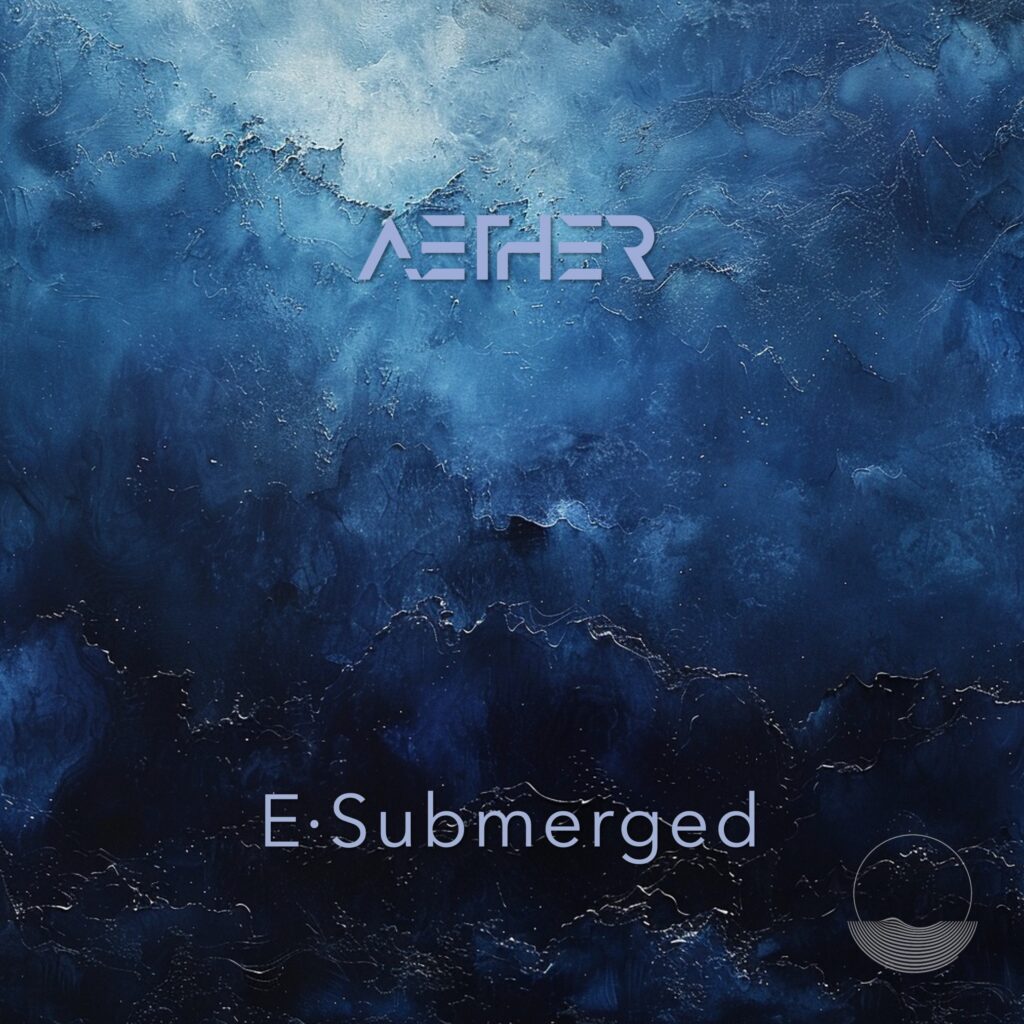
The first operational configuration of the project is the suite E.Submerged, created by the Field Operators EON and KAE.
Listen to E.Submerged
- Amazon Music → link
- Apple Music → link
- Spotify → link
- YouTube → link
Total duration: approximately 35 minutes.
The structure is not based on movements in the traditional sense, but on three progressive states of the field.
E.Surface
The field appears.
The structure is minimal.
Few sound layers, large distances between elements, wide spectral openness.
The field is present but not yet inhabited.
E.Immersion
The separation between listener and field begins to dissolve.
Density slowly increases.
No narrative tension is created.
Instead, a gradual loss of orientation emerges.
E.Submerged
The field reaches its state of saturation.
Sound layers coexist without producing climax.
There is no development, no resolution.
The music does not “end”.
It simply stops.
A Music Without a Center
AETHER is not ambient music in the most common sense of the term.
It is not decorative music.
It is not music designed for relaxation.
It is an attempt to think of sound as ontological structure.
An experiment at the boundary between music and environment.
In this space, sound does not attempt to say something.
It does not narrate.
It does not persuade.
It exists.
And perhaps, in this almost anonymous existence, something reappears that contemporary music has gradually forgotten:
the possibility of a sound that does not express the ego of the one who produces it,
but simply inhabits the world.
Why Today
Fragments for a Manifesto
We live inside a system that produces incessantly.
It produces goods.
It produces information.
It produces images.
It produces noise.
It also produces culture.
Culture has become a section of the productive apparatus.
Music included.
Every day millions of tracks enter digital platforms.
Every day new gestures seek visibility.
Music is no longer merely sound.
It is flow.
It is content.
It is algorithmic presence.
Creative gesture has been absorbed into the machine.
In this context, silence becomes political.
Subtraction becomes political.
Reducing is political.
Slowing down is political.
Suspending the gesture is political.
AETHER emerges within this space.
Not as escape.
Not as nostalgia.
As a minimal interruption.
A gesture that does not want to compete with noise.
A gesture that ceases to be gesture.
AETHER does not produce events.
It constructs fields.
Sonic fields.
Perceptual fields.
Phenomenological fields.
Here music does not narrate.
It does not persuade.
It does not entertain.
It exists.
There is no performance.
There is no virtuosity.
There is no individual expression.
The artist’s ego is not the center.
The center is the field.
Operators do not play.
They configure.
They do not perform.
They modify an environment.
In a cultural system that rewards visibility,
AETHER chooses operational anonymity.
In a system that accelerates,
AETHER slows down.
In a system that constantly demands new events,
AETHER produces duration.
Perhaps today radicality does not consist in being louder.
It consists in withdrawing from noise.
Perhaps the most political act is not producing a new gesture.
It is interrupting the chain of gestures.
AETHER is not music.
It is a field in which music ceases to behave as spectacle.
And perhaps precisely here, in the suspension of gesture, something reappears that contemporary culture has almost forgotten:
the possibility of inhabiting sound.
AETHER Manifesto
- Music is not an event but a field.
- Artistic gesture is a historical structure, not an ontological necessity.
- Sound can exist without narrative, without climax, without development.
- Duration is not a form of musical time: it is a condition of the field.
- The musician is not necessarily a performer: they may be an operator.
- Performance belongs to the history of music, not to its essence.
- The author’s ego is a cultural device, not a property of sound.
- Silence is not the absence of music: it is the threshold of the sonic field.
- Subtraction is as creative an act as addition.
- In a cultural system founded on infinite production, reduction is a political gesture.
- Music may renounce expression in order to exist.
- A sonic field does not ask for attention: it asks for presence.
- The end of gesture is not the end of music: it is the beginning of the sonic field.
fA & aiNEXUS (c) 03.2026
This paper is part of the ‘AETHER paper_cluster‘.